

From osprey to dolphin, the wild side of Virginia’s River Realm is always on display. Where the Wild Things Are is a growing wildlife-spotting library designed to help you discover theflora and fauna that call this region home. Browse by season, learn what to look for, and find public places where these species are commonly seen, whether by boat, by paddle, or on foot.

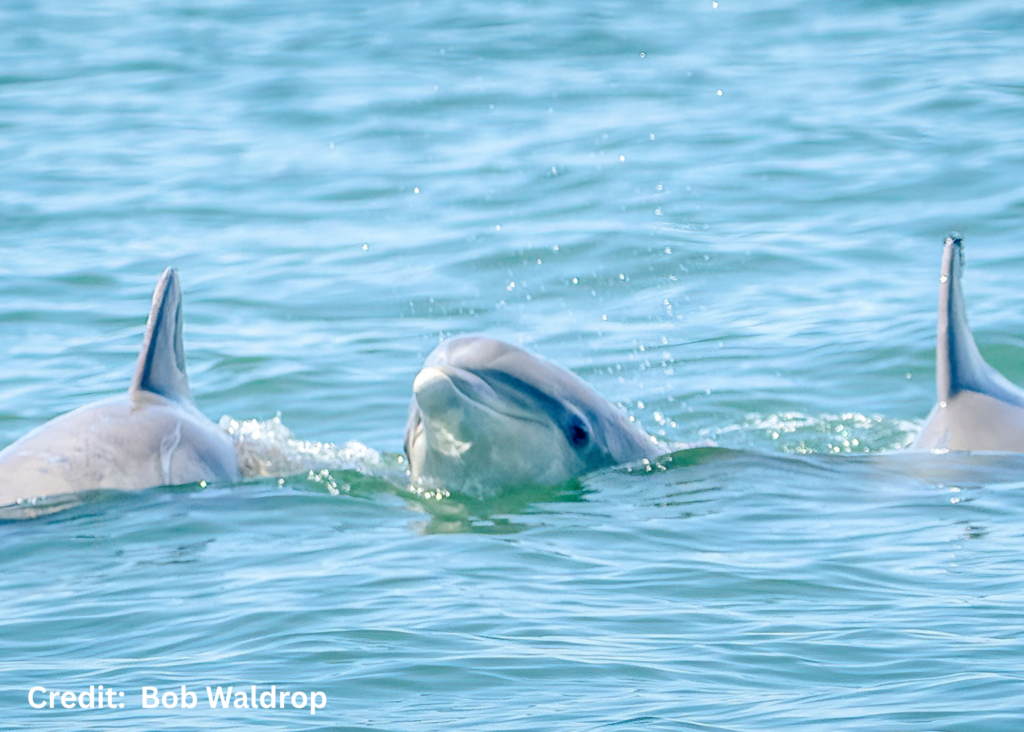
Seeing dolphins in the Rappahannock River isn’t the kind of thing you forget. Bottlenose dolphins venture into Virginia’s River Realm each summer, following baitfish and seasonal warmth up from the bay. They’re most reliably spotted near the mouth of the Rappahannock and increasingly further upstream, making any boat trip on the river a potential encounter.
A rounded dorsal fin breaking the surface is usually your first sign, followed by the characteristic arching roll as they move through the water. Adults reach 6 to 12 feet and are unmistakable once you spot the familiar silhouette.
June through September, with peak activity in July. Your best chances are during the calmer hours of early morning or late afternoon, when the river surface is still and fins are easiest to track.
Dolphins follow baitfish, so focus your search on the open stretches of the Rappahannock near its mouth and in the broader river channel. Boat trips and chartered cruises offer the best vantage points, though dolphins have been spotted from shoreline access points as well. If you see fins, keep your distance and enjoy from where you are.
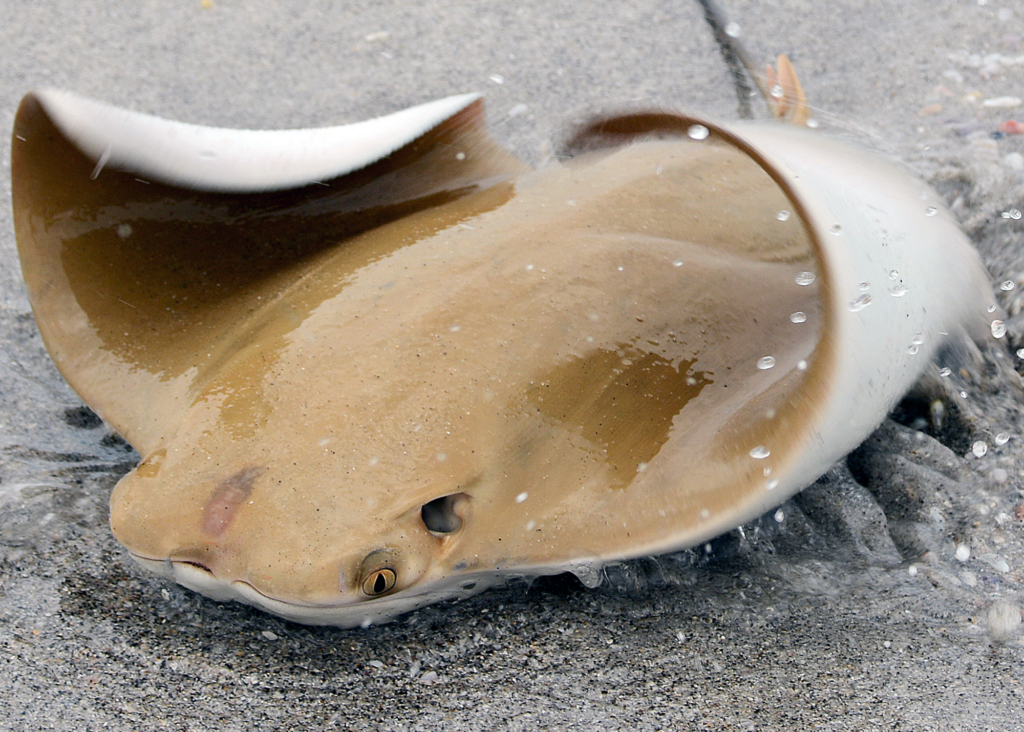
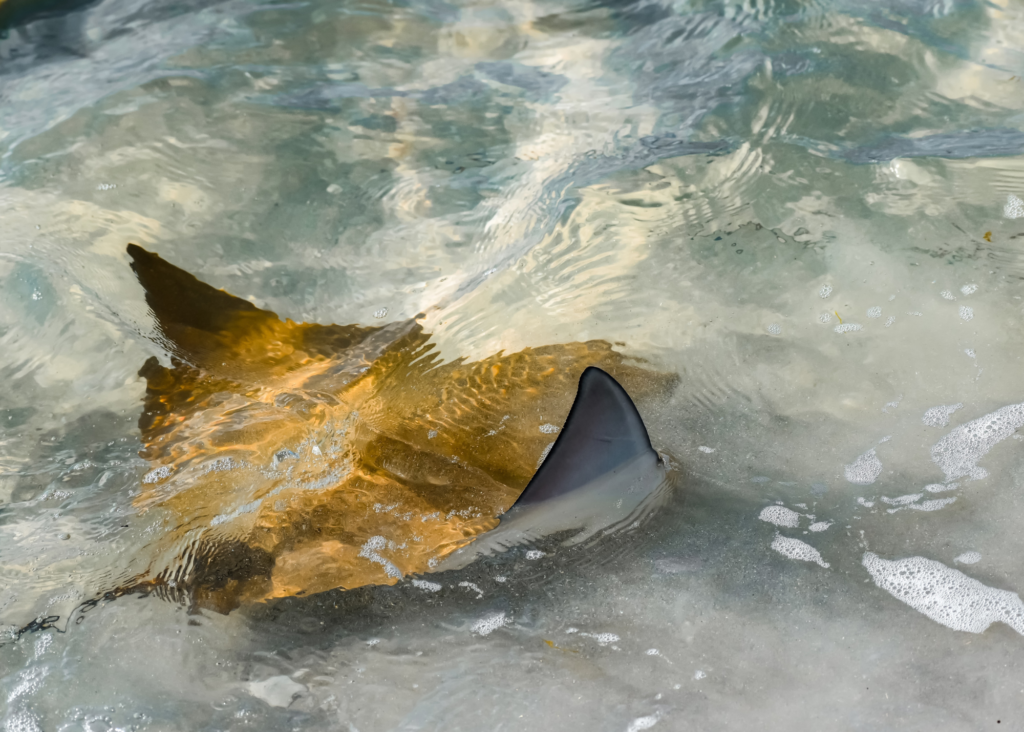
In 1608, Captain John Smith was stung by a ray while wading in the Rappahannock, near what is now called Stingray Point (in Deltaville). The species responsible was the cownose ray, which still passes through these waters every summer. Schools of rays travel together in the warm months, their wingtips sometimes breaking the surface in a pattern that has startled more than a few boaters who mistake them for sharks. There’s over 400 years of history in these waters, and this is one of the oldest chapters.
Look for a dark, flat, diamond-shaped silhouette just below the surface, or paired wingtips cutting through the water. Cownose rays have a wingspan up to three feet and a distinctive notched front edge on their disc that gives them their name.
May through September, with peak movement in summer. Schools can be quite large and are most commonly seen from a boat in open, warm water.
Cownose rays prefer warm, open tidal water and are most often spotted from boats traveling through the wider stretches of the Rappahannock and its tributaries. The waters near Stingray Point and Deltaville are historically significant territory for this species, making the area around the Deltaville waterfront a natural starting point.

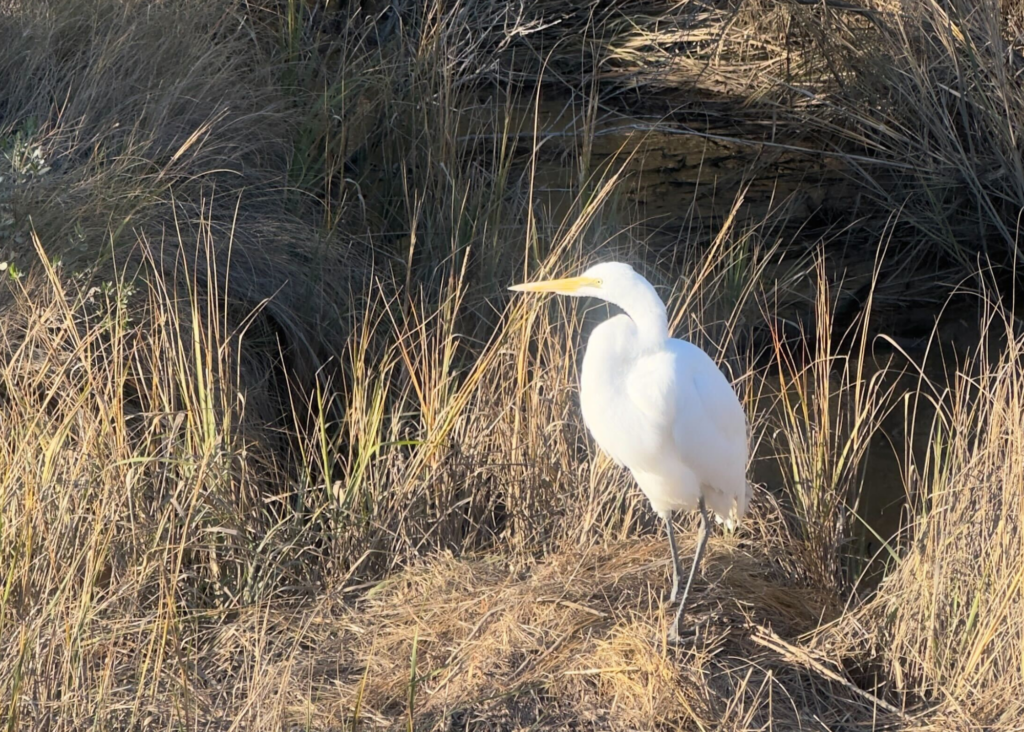
The Great Egret is one of the most striking birds you’ll encounter in Virginia’s River Realm, and summer is when they’re most reliably on display in the tidal marshes. Tall, all white, and completely unhurried, they stand in the shallows and wait out their prey with the kind of patience that’s almost meditative to watch. They’ve been a fixture of these waterways year-round for years, but warm weather brings them out in greater numbers and into more accessible spots.
Large white heron, standing up to four feet tall, with a bright yellow bill and long black legs. In summer breeding plumage, adults develop long, wispy feathers along the back. In flight, the neck folds back into an S-curve, which distinguishes them from other large white birds.
Year-round in the River Realm, with peak activity and visibility in summer. Most active during the cooler parts of the day at tidal marsh edges and along tidal creek shorelines.
Great Egrets feed in shallow tidal water, standing motionless before striking at fish, frogs, and invertebrates. Look for them wading at the edge of tidal marshes, along creek banks, and in the shallows near public access points. They’re easy to spot from land and don’t require a boat.
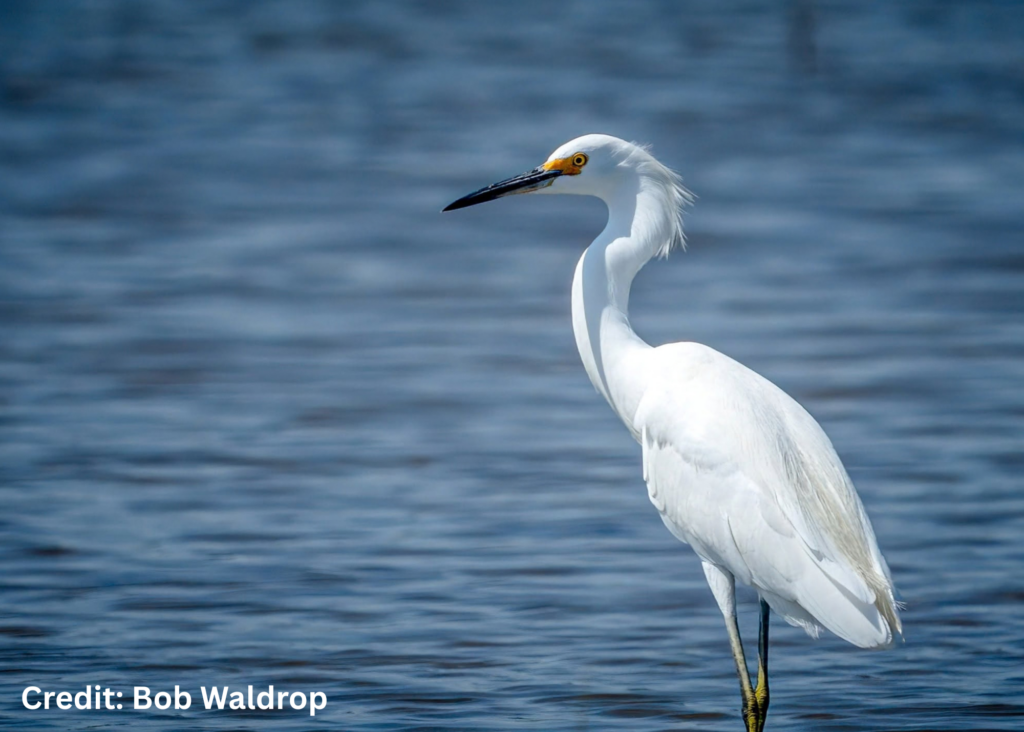
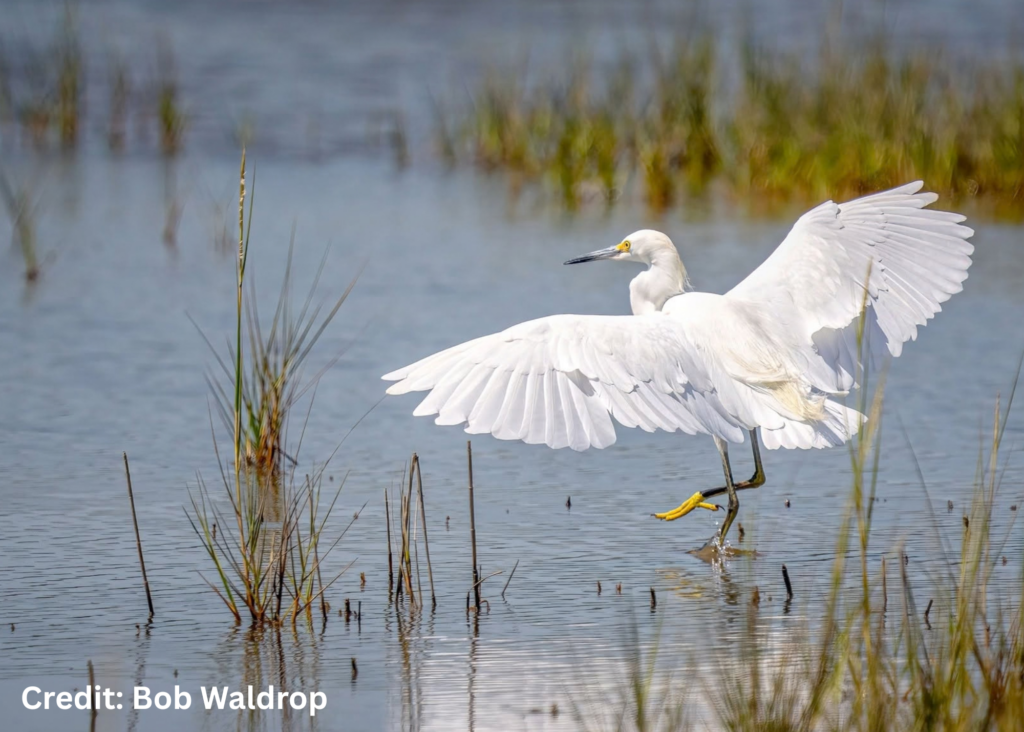
The Snowy Egret shares the marsh with its larger cousin the Great Egret, but you’ll know it by how it hunts. Where a Great Egret waits, a Snowy Egret works, stirring the mud with one bright yellow foot to flush out prey, then darting after it in short, sudden bursts. Smaller and more animated than most of the wading birds in the River Realm, it’s often the first sign that something interesting is happening at the water’s edge.
A slender white heron, smaller than a Great Egret, with a slim black bill, black legs, and bright yellow feet, sometimes called its golden slippers. In breeding season, adults grow delicate plumes on the head, neck, and back. Watch the feet more than the plumage; the yellow gives it away even at a distance.
Present from spring through fall, with the most activity in the warmer months when tidal flats and marsh edges are exposed at low tide. Look for it hunting actively rather than standing still; motion is often the first clue.Year-round in the River Realm, with peak activity and visibility in summer. Most active during the cooler parts of the day at tidal marsh edges and along tidal creek shorelines.
Present from spring through fall, with the most activity in the warmer months when tidal flats and marsh edges are exposed at low tide. Look for it hunting actively rather than standing still; motion is often the first clue.

Peregrine Falcons have reclaimed two Rappahannock River bridges as permanent nesting territory: Downing Bridge in Tappahannock and the Robert O. Norris Jr. Bridge connecting White Stone and Topping. Unlike most raptors that pass through seasonally, these pairs are year-round residents. They are among the fastest animals on earth, capable of exceeding 200 mph in a dive, and they hunt along the river corridor daily.
The nest boxes on both bridges are part of an ongoing conservation program led by Dr. Brian Watts at the Center for Conservation Biology at William and Mary. High-traffic bridges are dangerous places for young falcons to learn to fly: chicks that fledge over active roadways are frequently struck by vehicles before they can escape. Watts’s team monitors the nest boxes, captures the chicks before they are ready to leave the nest, raises them off-site, and releases them when they can survive on their own. It is one of the reasons Peregrine Falcons, once functionally extinct in the eastern United States, are now a reliable year-round sighting in Virginia’s River Realm.
Year-round. Nesting activity is most visible in spring, but the Tappahannock pair is reliably present through summer and can regularly be seen hunting over the river from the bridge or from the water below.
Nest boxes are located on two bridges along the Rappahannock: Downing Bridge (Route 360) on the Tappahannock side, and the Robert O. Norris Jr. Bridge connecting White Stone and Topping. Neither bridge is open to foot traffic, but both pairs are visible with binoculars from the shoreline. For Downing Bridge, scan from Rappahannock River Park. For a water-level view, launch from the DWR Boat Ramp at the Moose Lodge in Tappahannock, just upstream from the bridge. For the Norris Bridge pair on the Middlesex side, Mill Creek and Wake Beach are the closest shoreline viewing points.
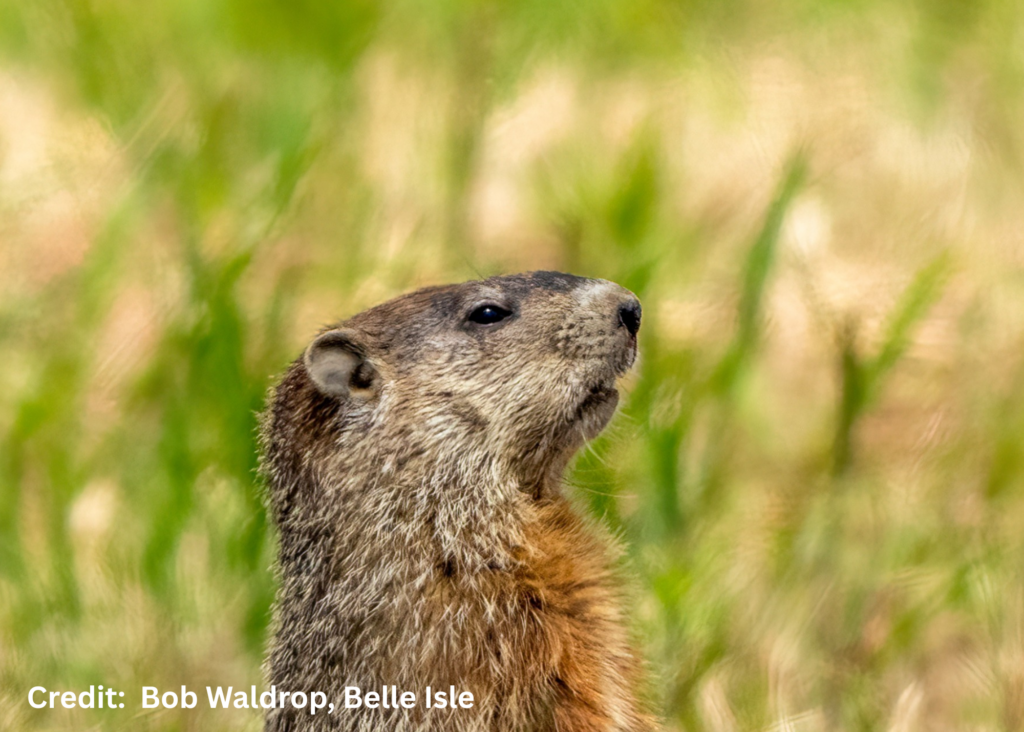
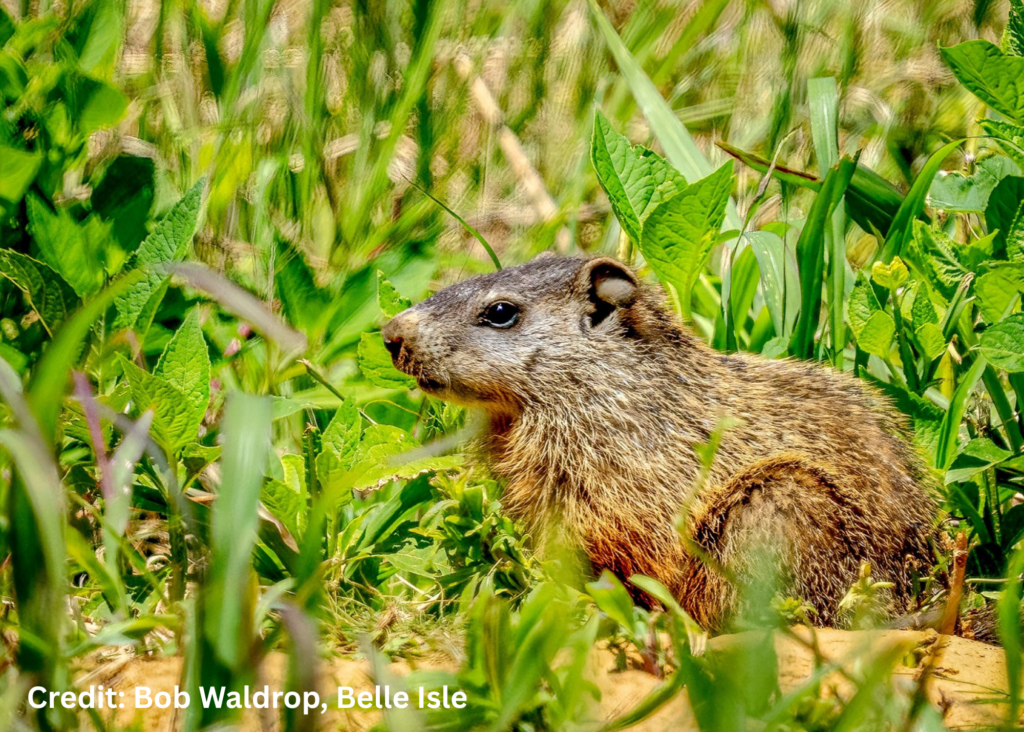
The groundhog is one of Virginia’s River Realm’s most reliably spotted summer residents, and you don’t need to go near the water to find one. These stout, sandy-brown mammals are a fixture of the region’s roadsides, open fields, and park edges from late spring through early fall, when they spend their days grazing, sunning, and keeping a close eye on whatever’s nearby. Young of the year emerge in late spring and are most visible through the summer months, making July and August peak groundhog season whether you’re looking for one or not.
A stocky, low-to-the-ground mammal about 16 to 20 inches long with a rounded body, short legs, and a bushy tail. Fur is brownish-grey. Often seen sitting upright on its haunches at the edge of a field or roadside before ducking into a burrow when approached.
May through September, with young animals most visible in July and August. Most active in morning and late afternoon. Look for them at the edges of fields, mowed areas near tree lines, and park picnic areas.
Groundhogs favor open ground near wooded cover, including roadsides, field edges, park lawns, and the transition zones between forest and open space. No special habitat or timing required. Drive any rural road in the River Realm in summer and the odds are in your favor.
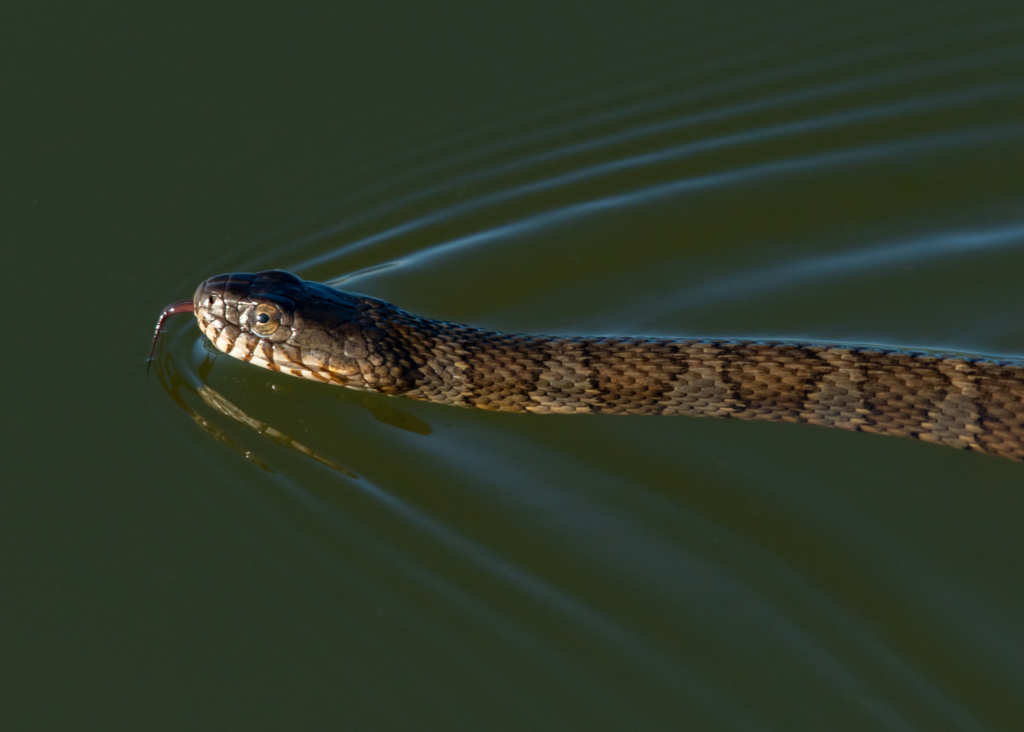
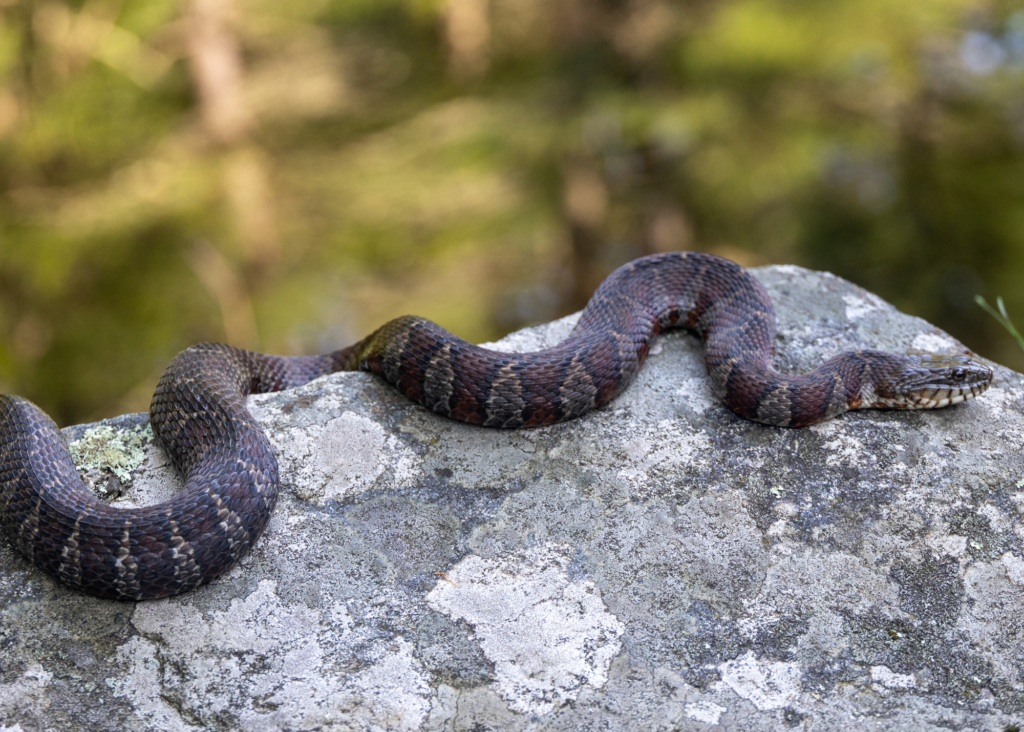
Northern water snakes are one of the most commonly spotted reptiles in Virginia’s River Realm in summer, and they almost always cause a double take. Thick-bodied and patterned, they drape themselves across logs and low branches extending over the water to bask, and they’re frequently (and incorrectly) assumed to be venomous. They’re not. The northern water snake is completely harmless and turns up along riverbanks, creek edges, tidal marshes, and freshwater streams throughout the region.
A stout, medium to large snake (24 to 55 inches) with dark brown or grey crossbands that become less distinct toward the tail. Often found motionless on a log or branch over the water. When disturbed, they drop into the water and swim with the body riding high on the surface, which is characteristic.
Active spring through fall, with peak basking behavior on warm summer days. Most visible in the late morning when logs and branches along the waterway are warmed by the sun.
Look for them on logs, low branches, and root masses extending over any slow-moving waterway in the region: tidal creek edges, freshwater ponds, riverbanks, and swamp forests. They’re often spotted from a kayak or from a quiet shoreline trail before they slip into the water.
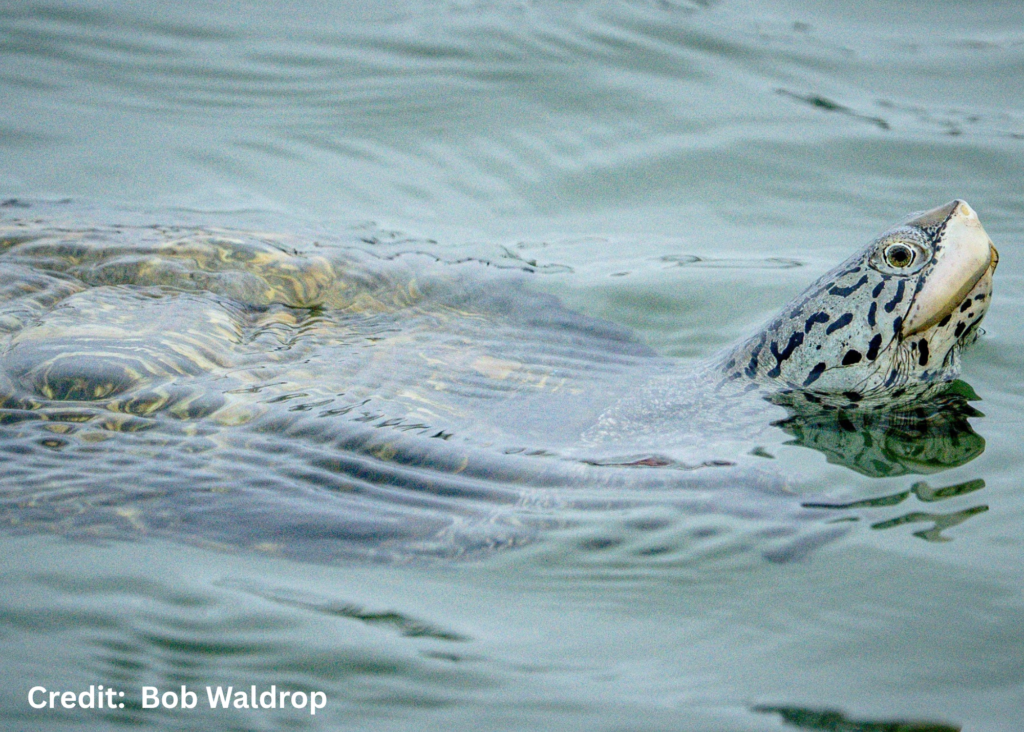
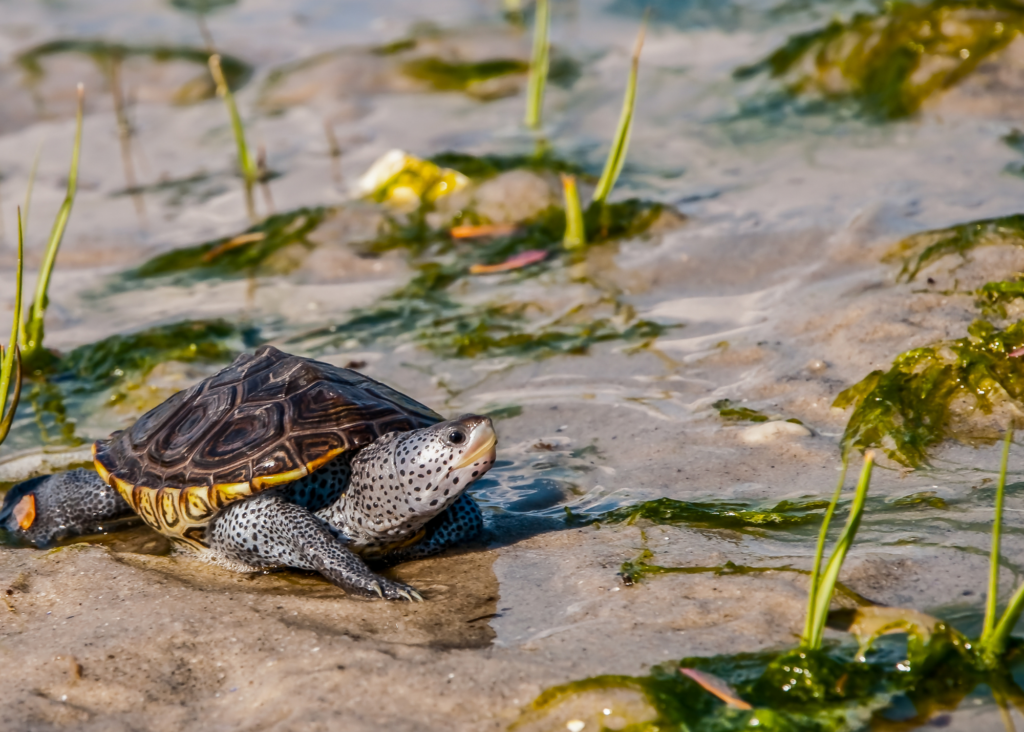
The diamondback terrapin is the only turtle in the world that spends its entire life in brackish water, the mixing zone where rivers meet the sea. June and July are nesting months, when females come ashore on sandy beaches above the high tide line to lay their eggs. Look closely at the shell rings: each one represents a year of growth, and no two terrapins carry the same pattern.
A medium-sized turtle (4 to 9 inches) with a grey or brown shell marked by concentric diamond-shaped rings. The skin is pale grey with dark spots and speckles, which is distinctive among local turtles. Most often spotted basking on logs or swimming just below the surface in calm, shallow tidal water.
Active spring through fall, with nesting females most visible on sandy beaches in June and July. Look for them basking on logs or swimming in calm coves and tidal creek edges throughout summer.
Diamondback terrapins favor brackish marshes and the edges of tidal creeks and rivers where sandy beach habitat exists. Hughlett’s Point is a confirmed nesting site, where females come ashore on the undeveloped beaches above the high tide line in June and July. Keep an eye on exposed logs, sunny shoreline sections, and calm cove areas while paddling or boating.
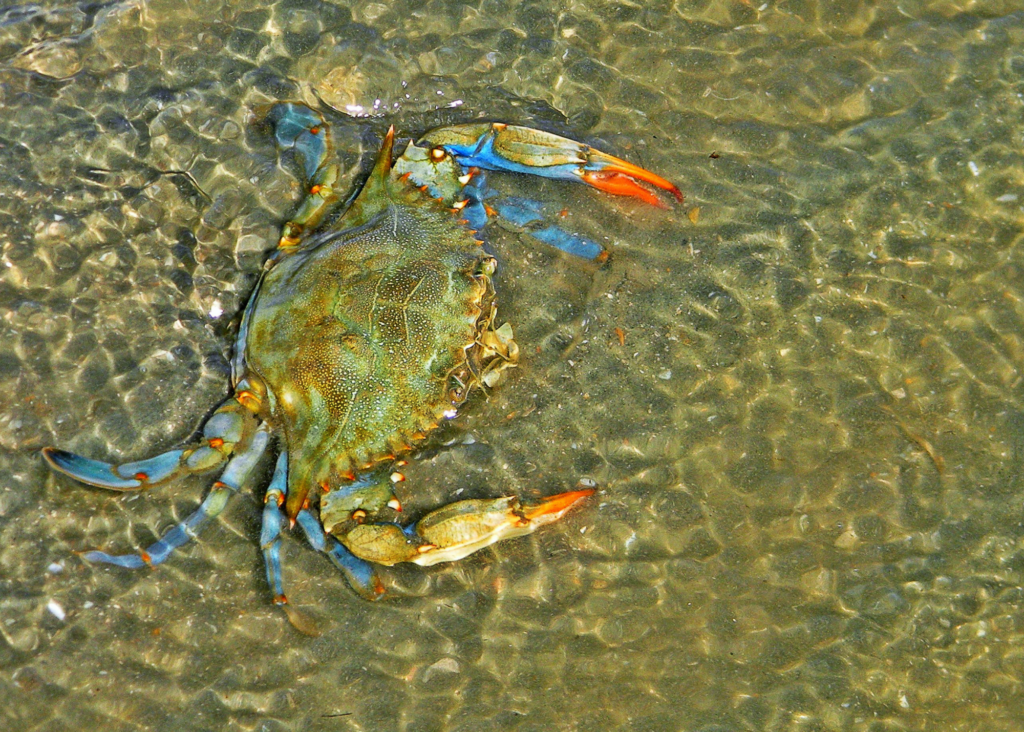
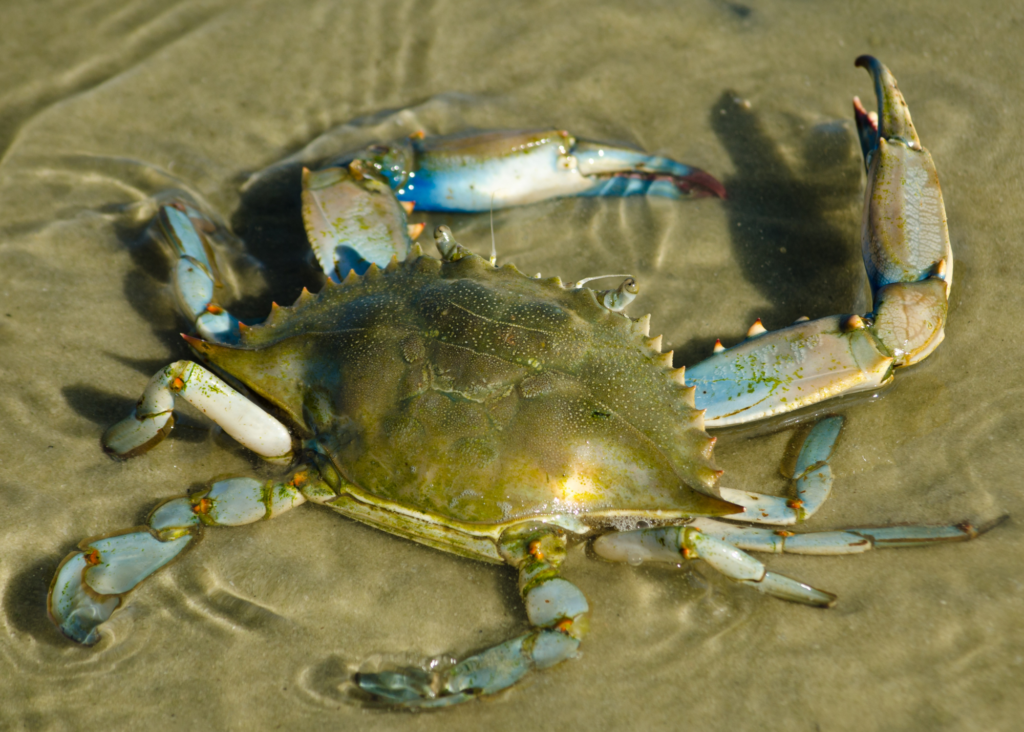
The blue crab is the signature species of the Chesapeake region and the foundation of the River Realm’s working waterfront economy. Watermen have crabbed these waters for generations, timing their harvests around the crab’s life cycle, including the peeler stage, when crabs shed their shells to grow and become briefly soft and edible whole. Peak mating season runs through the warmest months, and the underwater grass beds in the tidal Rappahannock serve as critical nursery habitat for juveniles. This is the rare species that works at every level: something to spot from a kayak in the shallows, and something to order by the dozen at a riverside seafood table.
Bright blue claws and an olive-brown shell up to about nine inches across. Females have orange-tipped claws; males do not. They’re quick in the water and will raise their claws in a defensive posture if cornered.
June through September, with peak activity in July and August. Most visible in the warmer, calmer stretches of tidal water and in the shallows around underwater grass beds.
Blue crabs favor tidal water near submerged grass beds, where they shelter, forage, and reproduce. Look for them from docks, shallow shoreline access points, and during slow paddle trips through grass-fringed coves. Guided kayak tours are also a reliable way to get close to the right habitat.
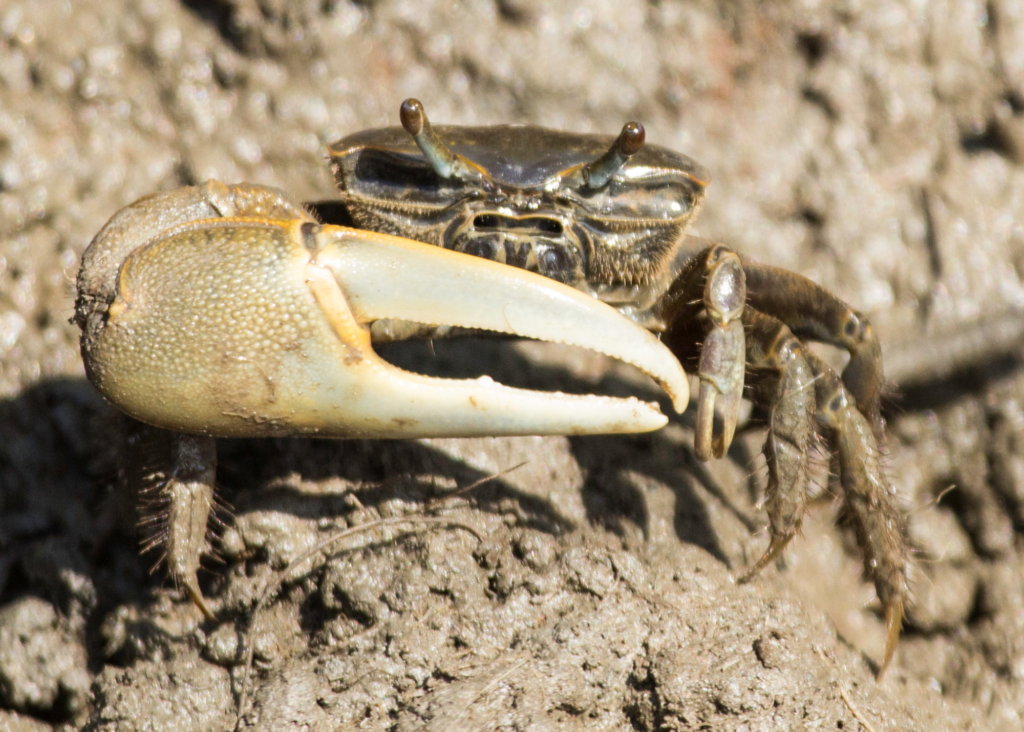
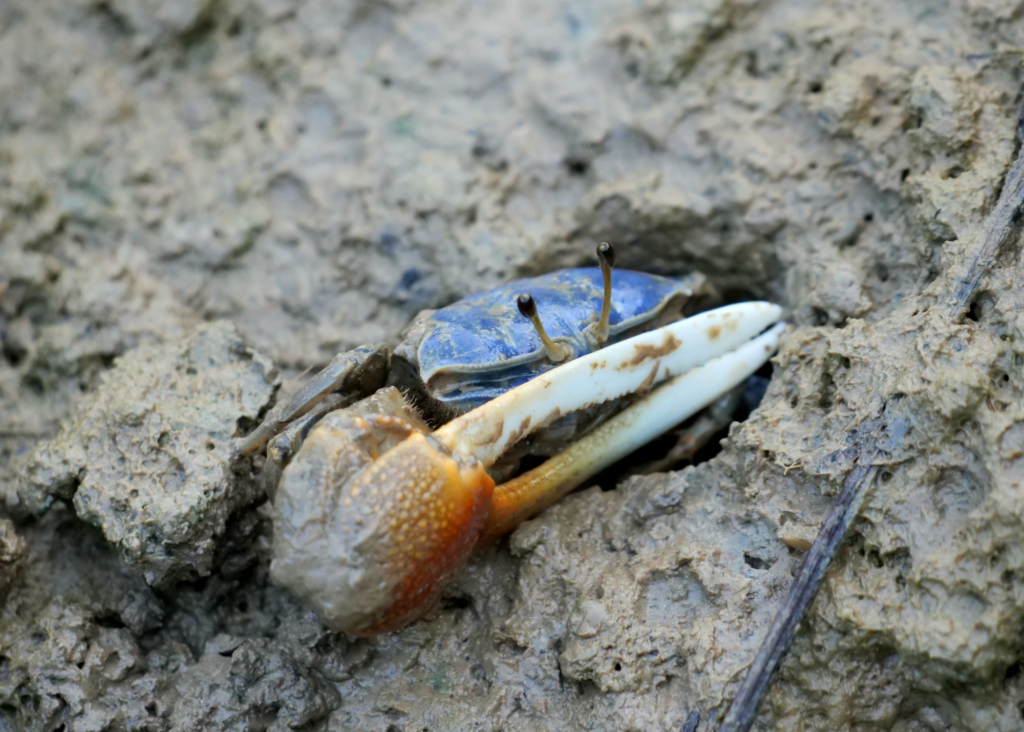
Fiddler crabs are one of those things you’ll walk right past the first time and spend the rest of the trip watching. These small tidal marsh residents emerge at low tide by the hundreds, working across the exposed mud flats at the edge of the spartina grass. Three species call this region home, and watching a male wave his oversized claw across a crowded tidal flat is one of the more entertaining moments a slow shoreline walk can offer.
Small (roughly an inch across the shell) and brownish, with one dramatically oversized claw on the males, which they wave rhythmically. You’ll almost always find them in groups on exposed mud at low tide rather than alone.
Active throughout summer, with the best sightings at low tide. Morning and late afternoon visits during low tide produce the most activity.
Look for tidal mud flats and the landward edges of spartina marsh. At low tide, colonies emerge from their burrows and spread across the exposed flat. Approach slowly from the upland side to observe before they retreat into the mud.
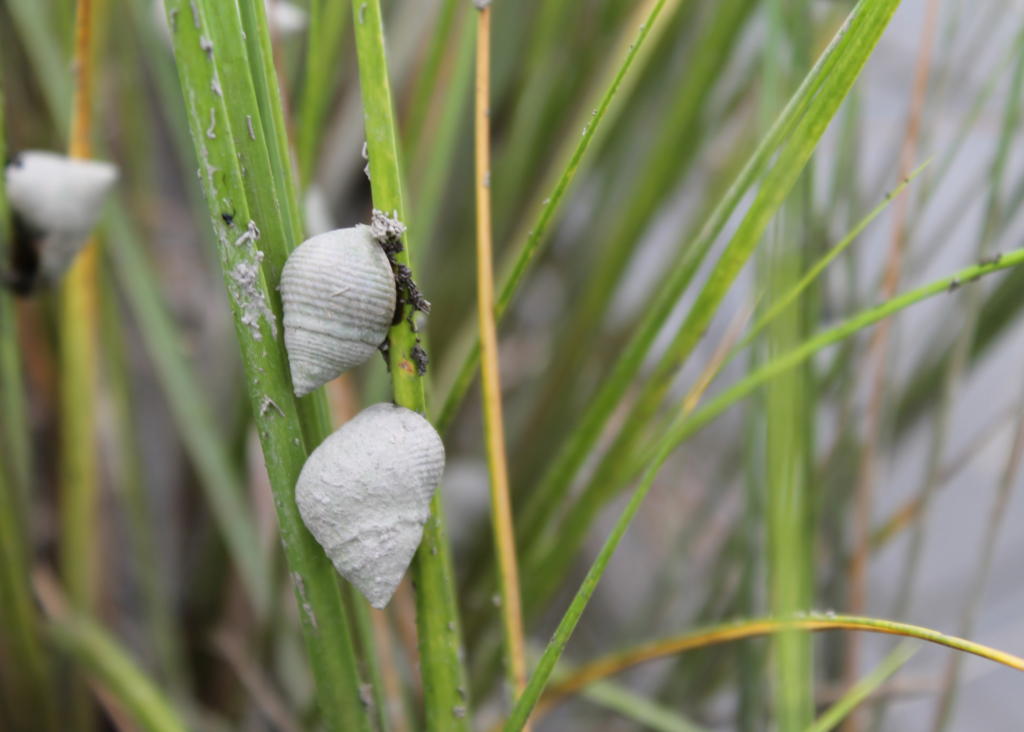
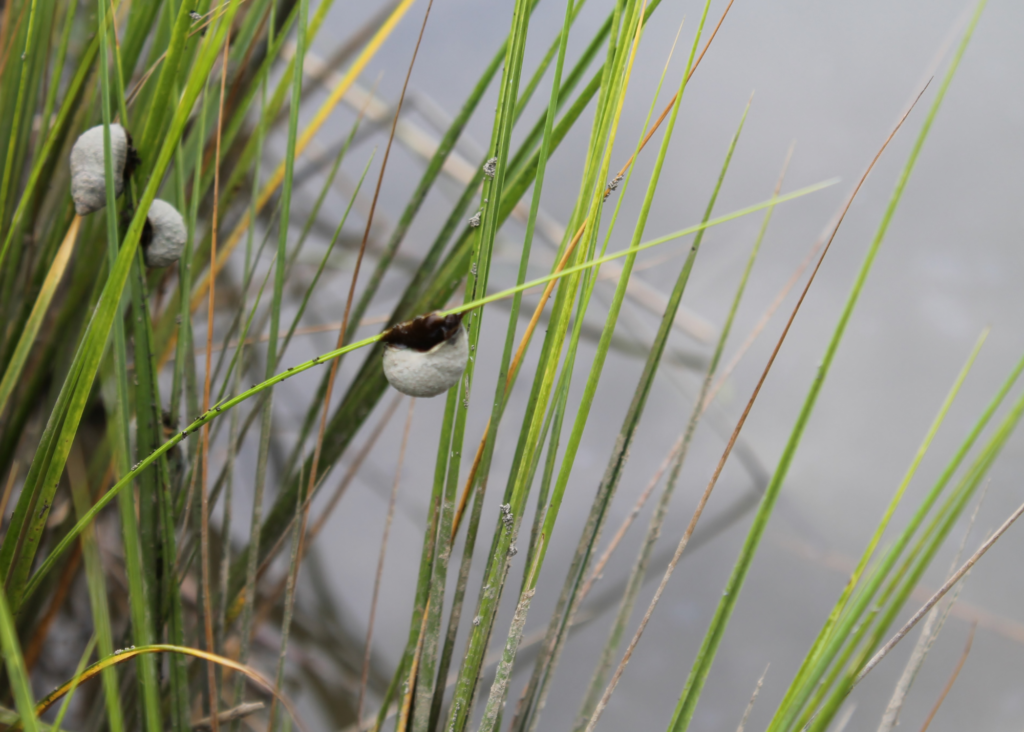
Periwinkles don’t get the headlines, but they’re worth a closer look. These small tidal snails cling to rocks, pilings, oyster shells, and marsh grass stems along the waterline throughout Virginia’s River Realm, pulling back into their shells when the tide drops and venturing out again when it rises. They’re one of the most accessible wildlife discoveries in the region: no boat, no binoculars, no special timing required. Just walk the shoreline and look down.
Small (about half an inch to an inch), rounded snails with a smooth, coiled shell in muted grey, tan, or dark brown. Found in clusters on any hard surface at the waterline, often barely moving. The shell opening is round with a flared lip.
Present year-round on tidal shorelines, but summer is the easiest time to explore. Best observed near high tide when they’re most active, or in the splash zone when the tide is dropping.
Look for them on any hard substrate at the tidal waterline: rocks, jetty stones, wooden pilings, and the bases of spartina grass clumps. Rocky shorelines and old piling structures are particularly productive. No wading required.
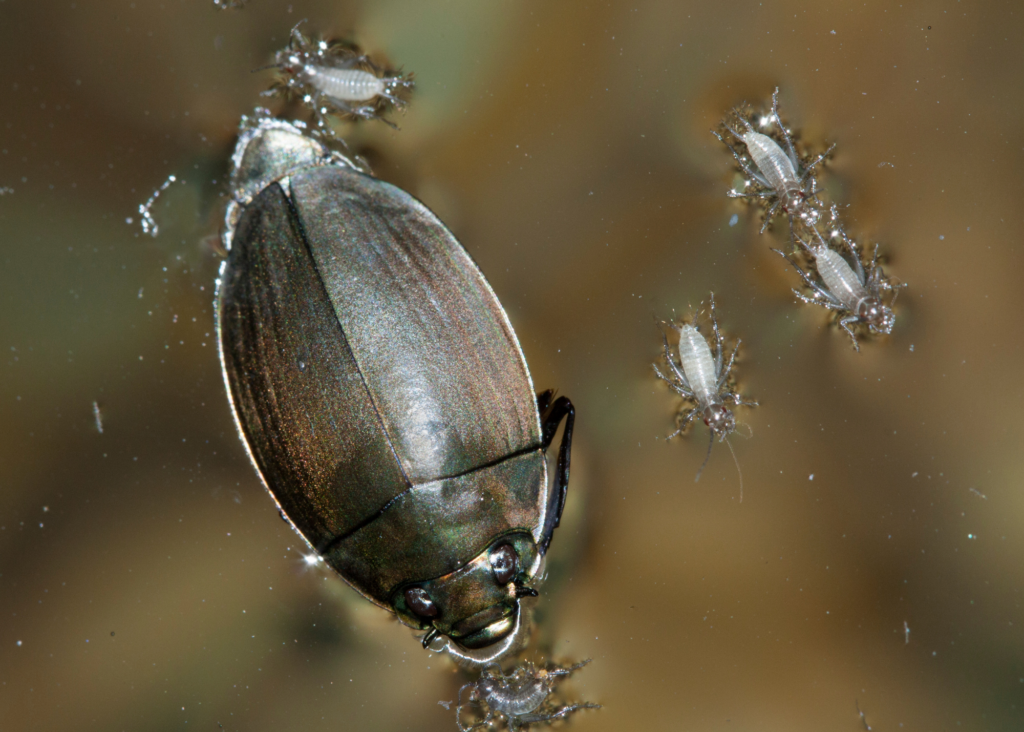
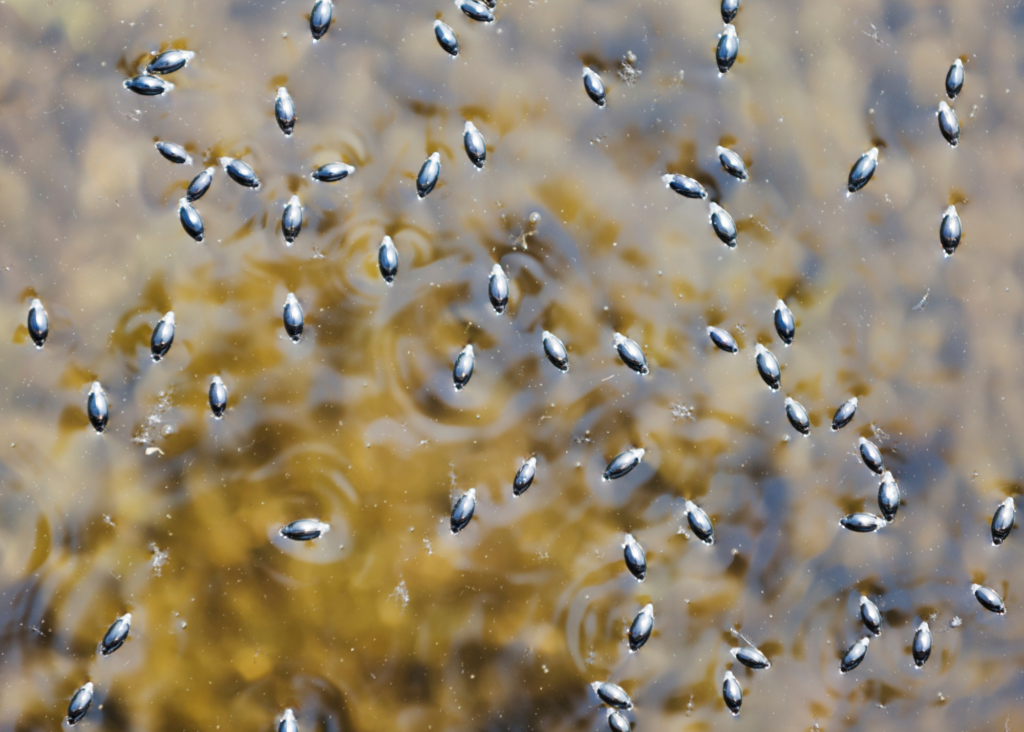
You might paddle right past a whirligig beetle and think you’re seeing a trick of the light. These small, metallic beetles spin in tight circles on the surface of slow-moving water, alone or in groups that can number in the hundreds, creating a gyrating pattern across the glassy surface. Summer is their peak season, and Dragon Run’s calm blackwater channels are prime territory. They are completely harmless, genuinely fascinating, and one of the stranger discoveries on a summer paddle through the swamp.
Small (1/4 to 3/4 inch) and metallic black or bronze, moving in rapid spinning and darting patterns on the water’s surface. Their eyes are divided horizontally, allowing them to see both above and below the waterline at the same time. You’ll recognize them by the motion before anything else.
Active through summer, with peak presence in the warmest months. Most visible on calm, still water in mid-morning or early afternoon when the light is at the right angle.
Whirligig beetles turn up on almost any slow-moving freshwater in Virginia’s River Realm: quiet pond edges, shaded creek backwaters, calm coves, and still-water stretches between patches of aquatic vegetation. You don’t need to travel far to find them. Look for groups spinning on the open surface in mid-morning when the light hits the water at the right angle. Dragon Run’s blackwater channels are a particularly productive spot.
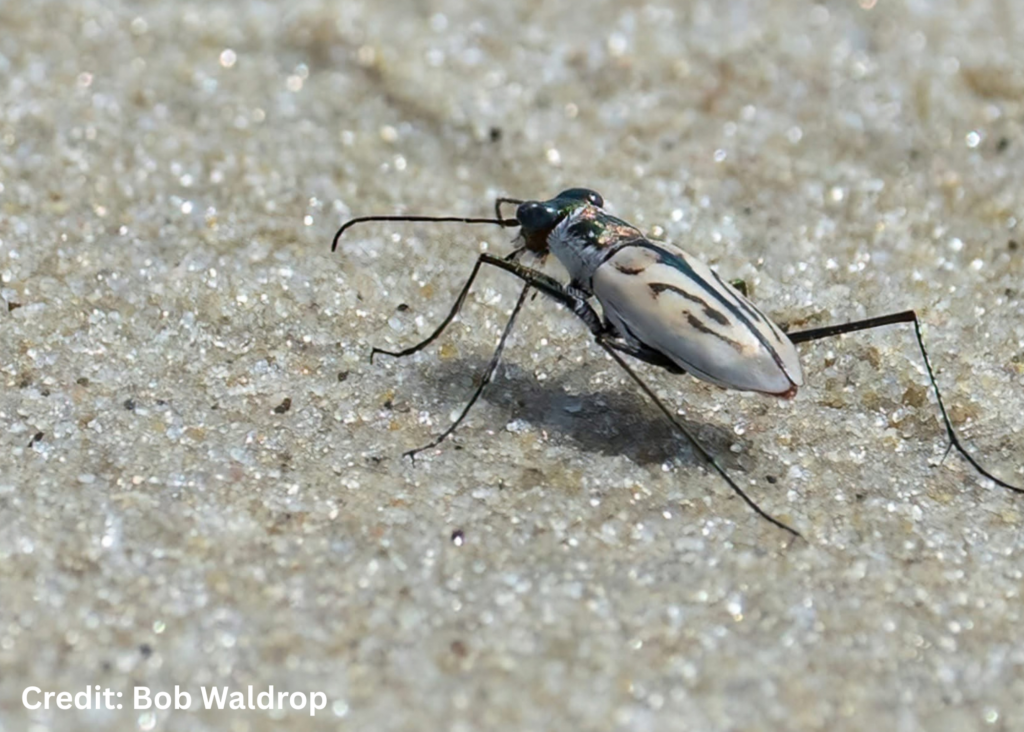
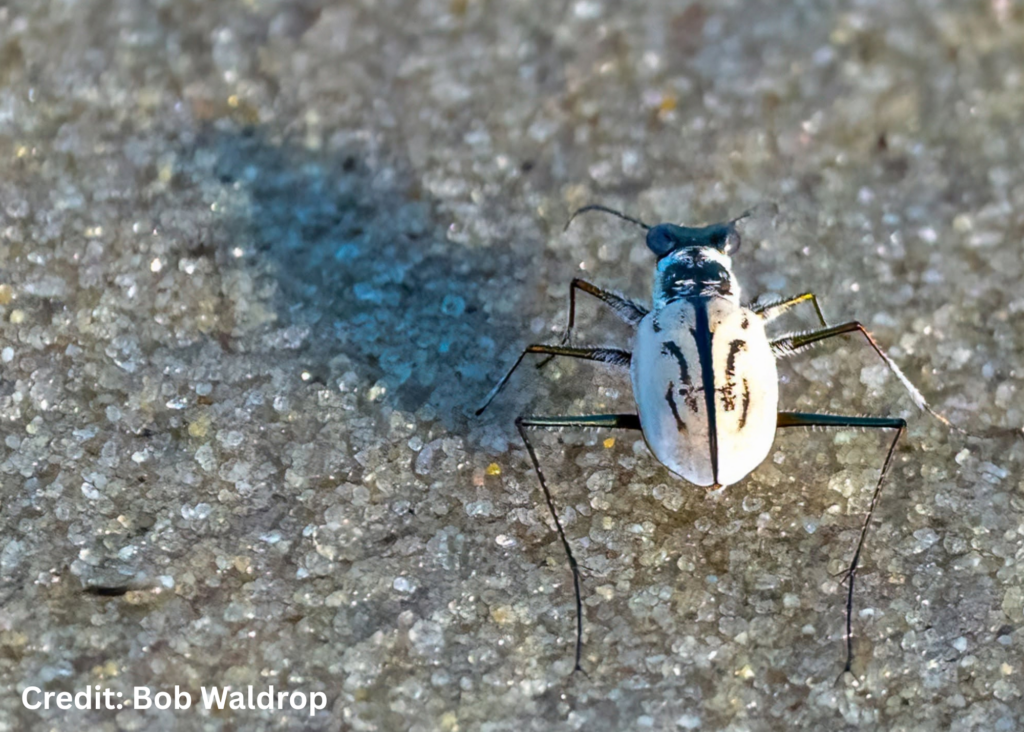
Tiger beetles are easy to miss and impossible to catch up to. They favor bare, sun-warmed sand and dirt, the open patches along a trail, a sandy river bluff, a stretch of beach, and when you get close, they don’t fly off so much as sprint a few feet ahead and stop, daring you to try again. Pound for pound, they’re some of the fastest animals on the ground in the River Realm, and one of the more entertaining accidental encounters on a summer walk.
Small, generally a half inch to three-quarters of an inch, long-legged, and often iridescent green, bronze, or coppery in bright sun, with large eyes and prominent curved mandibles. Look for the distinctive stop-start movement, a short, fast sprint followed by a pause, on open sandy or bare ground rather than in vegetation. A few different species turn up around the River Realm; the Chesapeake Bay beach at Hughlett Point is also documented habitat for the northeastern beach tiger beetle (Cicindela dorsalis dorsalis), a larger, federally threatened subspecies found on only a handful of Bay beaches.
Most active on warm, sunny days from late spring through summer, when bare sand and open trail or bluff surfaces heat up. Midday, when the sun is highest, is typically when they’re most visible and active.
Most active on warm, sunny days from late spring through summer, when bare sand and open trail or bluff surfaces heat up. Midday, when the sun is highest, is typically when they’re most visible and active.
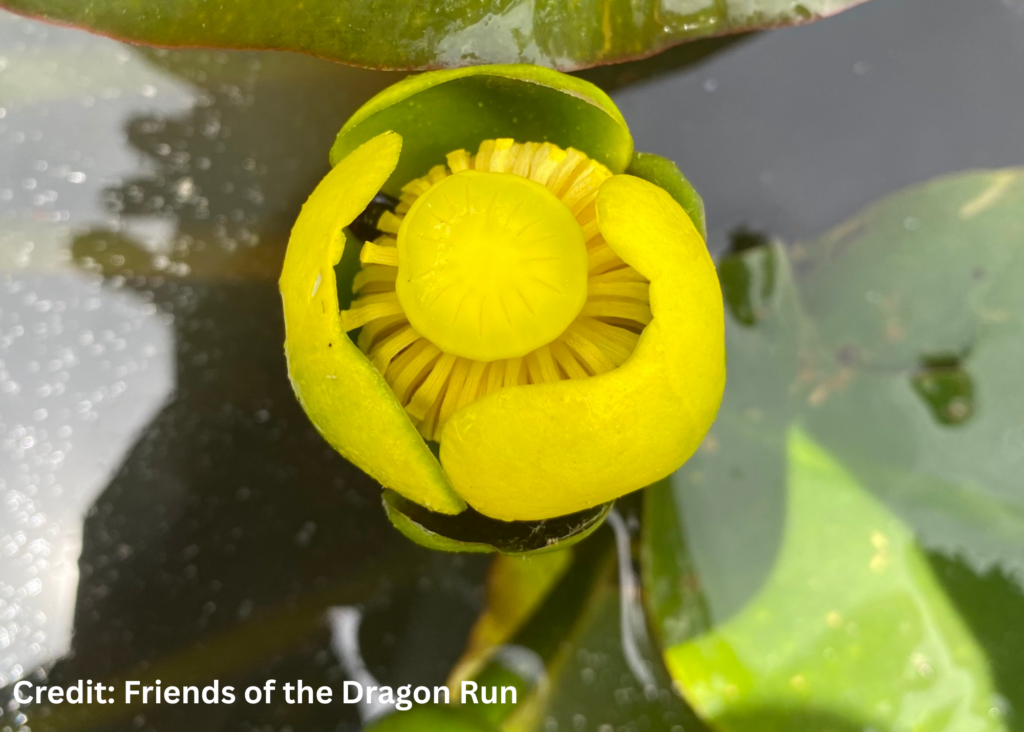
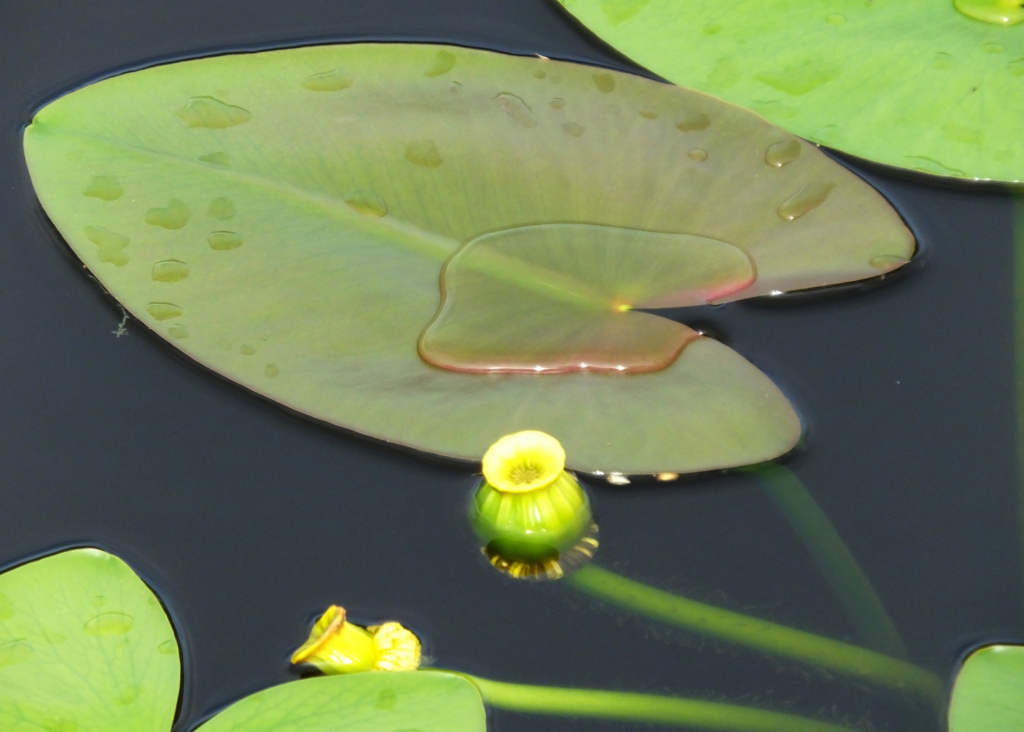
Spatterdock is one of the most recognizable aquatic plants in Virginia’s River Realm, turning up on slow-moving freshwater ponds, creek backwaters, and tidal freshwater margins throughout the region from late spring through fall. The large heart-shaped leaves float on the surface while yellow globe-shaped flowers rise above them from May through October. One theory for how Dragon Run got its name points directly to spatterdock: the thick, dragon-like roots visible in the shallows beneath the surface. It’s a plant that rewards slow travel, and whether you’re paddling a blackwater creek or walking a shoreline trail, it tends to be the first aquatic plant that stops people in their tracks.
Large, round floating leaves and a yellow flower that looks more like a ball than an open bloom, sitting on a thick stem above the waterline. The flower never fully opens, which makes it look distinct from other water lilies.
May through October, with peak blooms through summer. Most visible from a kayak or canoe at water level, which is also where you get the best photographs.
Spatterdock grows throughout the slow-moving freshwater of the region: ponds, creek backwaters, and tidal freshwater margins wherever the current slackens and the bottom is soft. Dragon Run is its most celebrated local address, where thick floating leaves blanket the blackwater channels from bank to bank, but patches turn up across the River Realm wherever conditions are right. A summer paddle is the most immersive way to find it, but it can also be spotted from shoreline trails and boat ramps adjacent to slow-moving water.
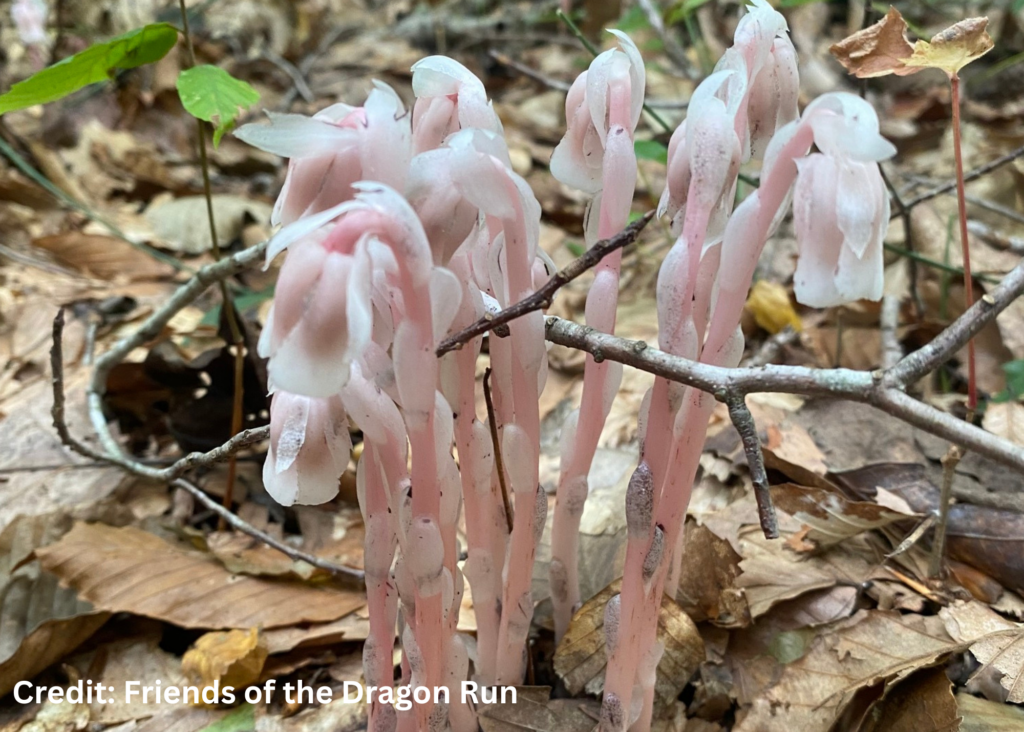
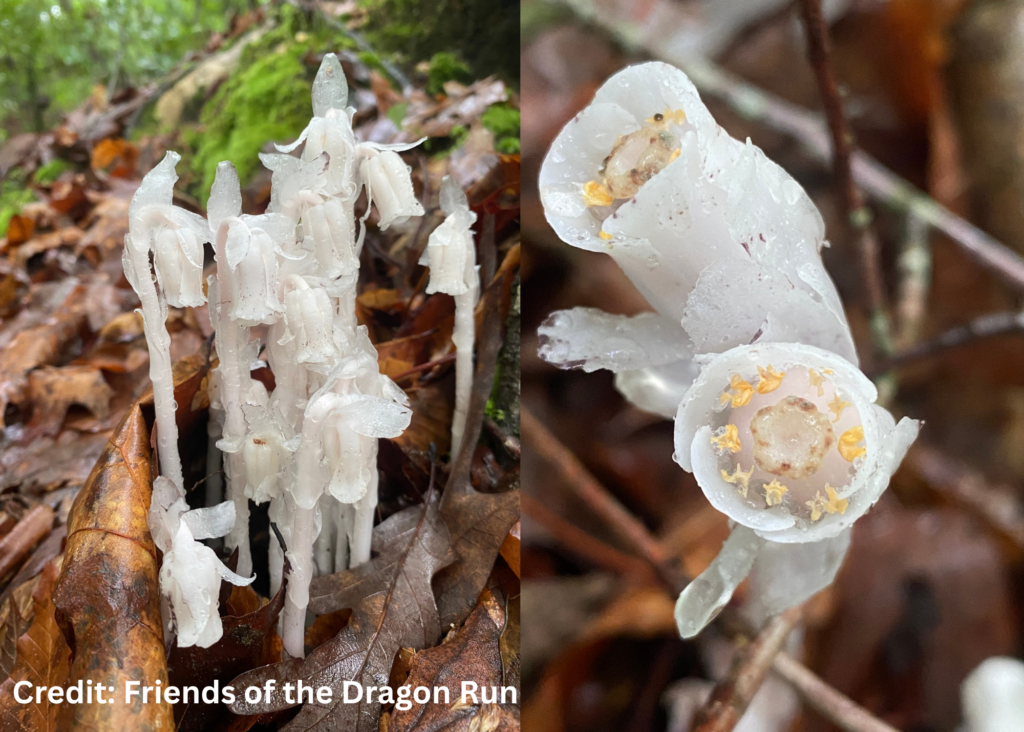
Ghost pipes are easy to miss the first time and impossible to forget after that. These white, waxy plants grow in clusters on the floor of mature, shaded forest from June through September, and unlike every other plant on this page, they do not photosynthesize. Instead, they pull nutrients directly from fungi in the soil, which is why they’re completely colorless: no chlorophyll, no green. Ghost Pipes is Virginia’s designated Wildflower of the Year for 2026, and a midsummer walk through the right woodland could turn up a colony rising quietly from the leaf litter.
White to translucent, 4 to 8 inches tall, with a single drooping flower head that straightens upright as it matures. Grows in small clusters on the deep-shaded forest floor with no leaves and no color. Waxy and ghost-like in appearance, there’s genuinely nothing else that looks like it.
June through September. They appear most reliably after periods of rain, when the soil conditions that support their host fungi are most active. Mid-summer is peak season.
Look in mature deciduous forest with deep shade and undisturbed leaf litter. Ghost pipes grow where their host fungi are present, often in older forest that hasn’t been cleared or heavily trafficked. Several of Virginia’s River Realm’s woodland preserves and forest trail systems offer access to the right conditions.
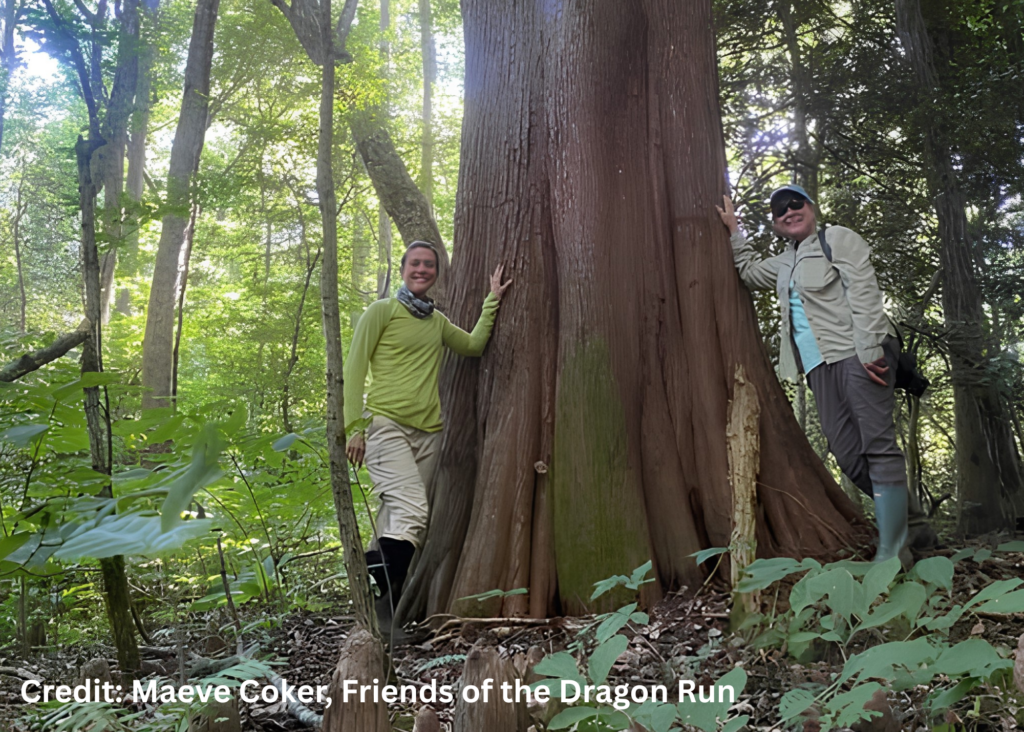

Dragon Run is one of the last intact blackwater swamp systems on the East Coast, and the Bald Cypress is its signature tree. These ancient conifers have been growing at the water’s edge for thousands of years, their trunks swelling at the base into massive buttresses, their roots sending up the distinctive knobby projections called knees that emerge from the waterline around them. On a summer paddle through Dragon Run, you move through a cathedral of them. The oldest trees here predate European settlement by centuries.
A tall, narrow conifer with soft, feathery needles arranged in flat rows along slender branchlets, nothing like the stiff, sharp needles you expect from most conifers. The foliage is bright green in summer and turns a warm russet-orange in fall before dropping entirely. Bald Cypress is one of the few deciduous conifers in North America, and that is where the name comes from: it goes bald. The most distinctive feature is the cypress knees, woody projections that grow upward from the root system and break the surface of the water around the base of the tree. Nothing else in the Realm produces them.
Year-round, but summer is the ideal season. The canopy is at its fullest and brightest from June through August, the water level on Dragon Run is well-suited for paddling to the base of the trees, and the Friends of Dragon Run’s guided summer paddle season runs directly through bald cypress territory.
Dragon Run is the primary location. The creek winds through one of the most significant concentrations of Bald Cypress remaining in Virginia, with some specimens estimated to be over 1,000 years old. The trees line the banks and grow directly from the water, creating the tunnel-like canopy experience that makes a Dragon Run paddle unlike anything else in the region. Teta Kain Nature Preserve offers trail access to the bald cypress swamp along Dragon Run without a guided paddle, and is managed by Friends of Dragon Run.
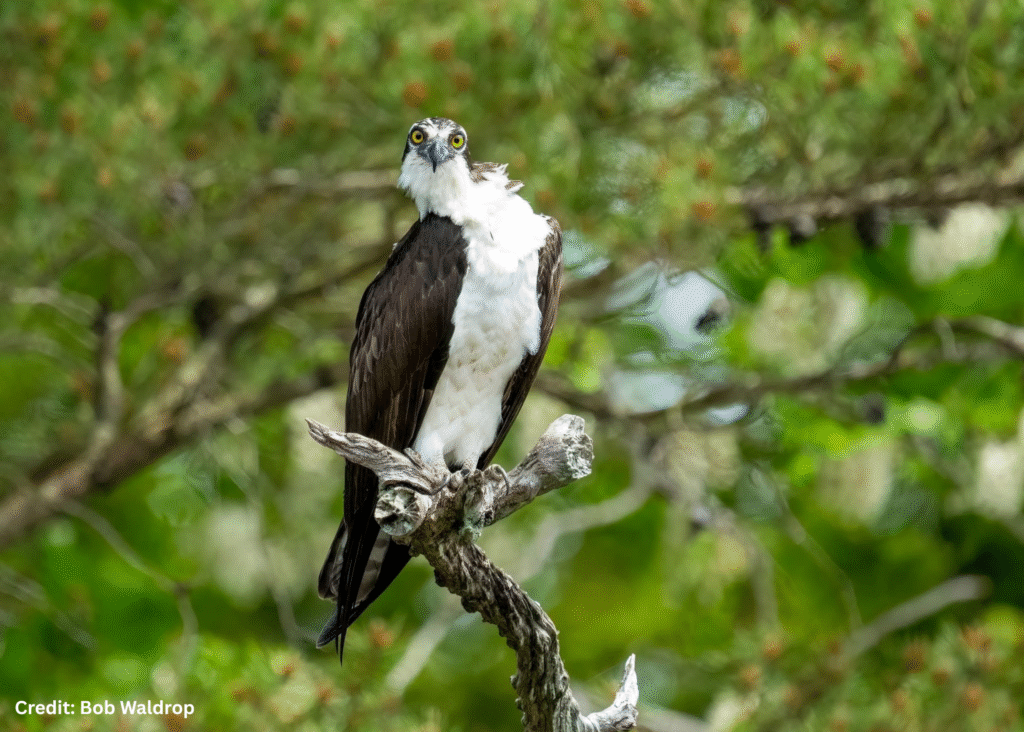
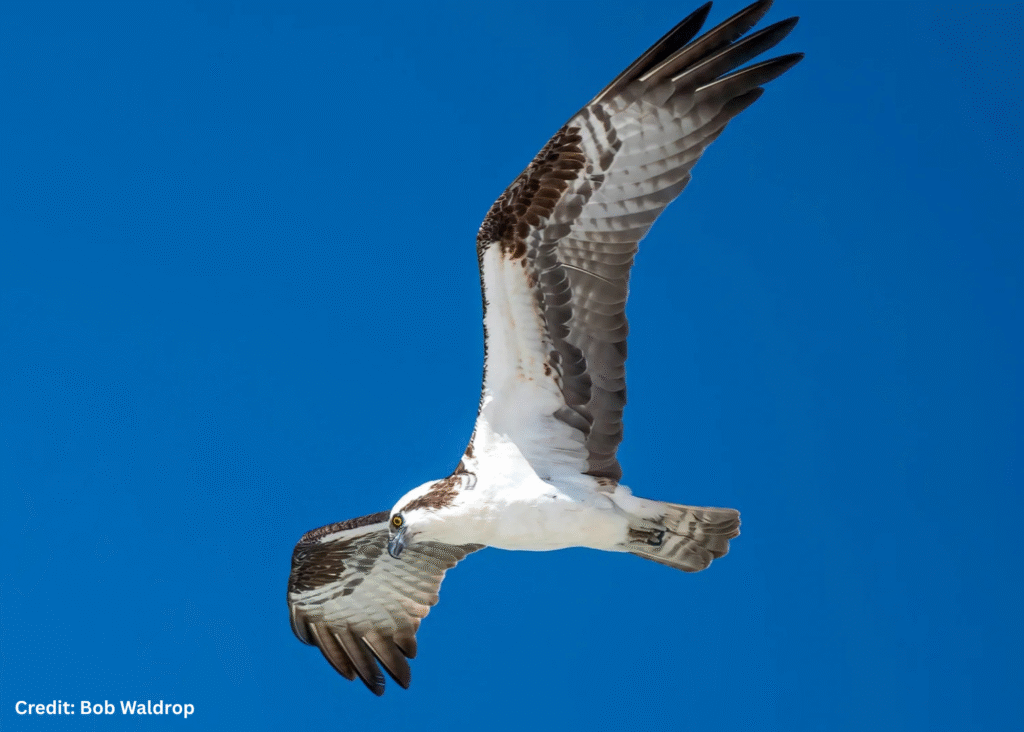
A true sign of spring in Virginia’s River Realm, Ospreys return each year to nest, fish, and raise their young along our rivers, creeks, and shorelines. Often called “Fish Hawks,” these striking raptors are known for their dramatic dives and are one of the most exciting birds to spot in Middlesex County and the surrounding River Realm as the warmer season begins.
Ospreys are large brown-and-white raptors with long, narrow wings, a white underside, and a bold dark stripe running through the eye; in flight, their wings appear slightly bent or “crooked” as they glide over the water.
Late March through early fall, with peak activity in spring and summer as Ospreys return to nesting sites and are frequently seen hunting over open water.
Osprey prefer open water with abundant fish and tall nesting structures nearby. Look for nests on dead trees along river shorelines and creek mouths, as well as on pilings and channel markers. For the best chance of spotting one, scan the water from a boat or visit one of our public waterfront access points for a good view from land.
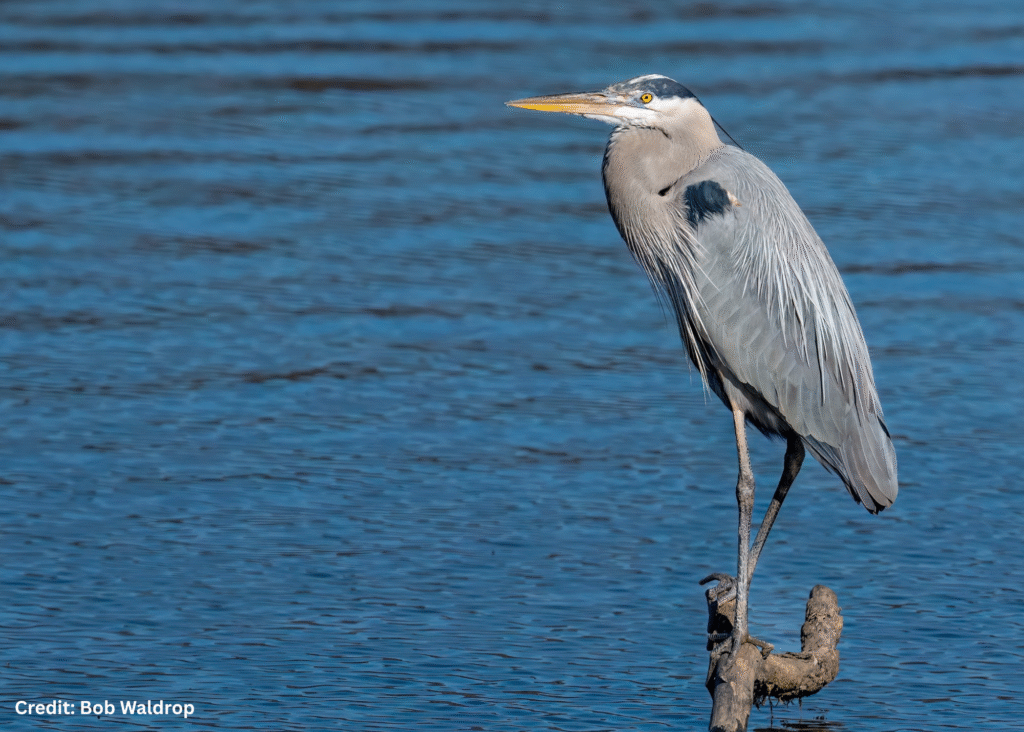
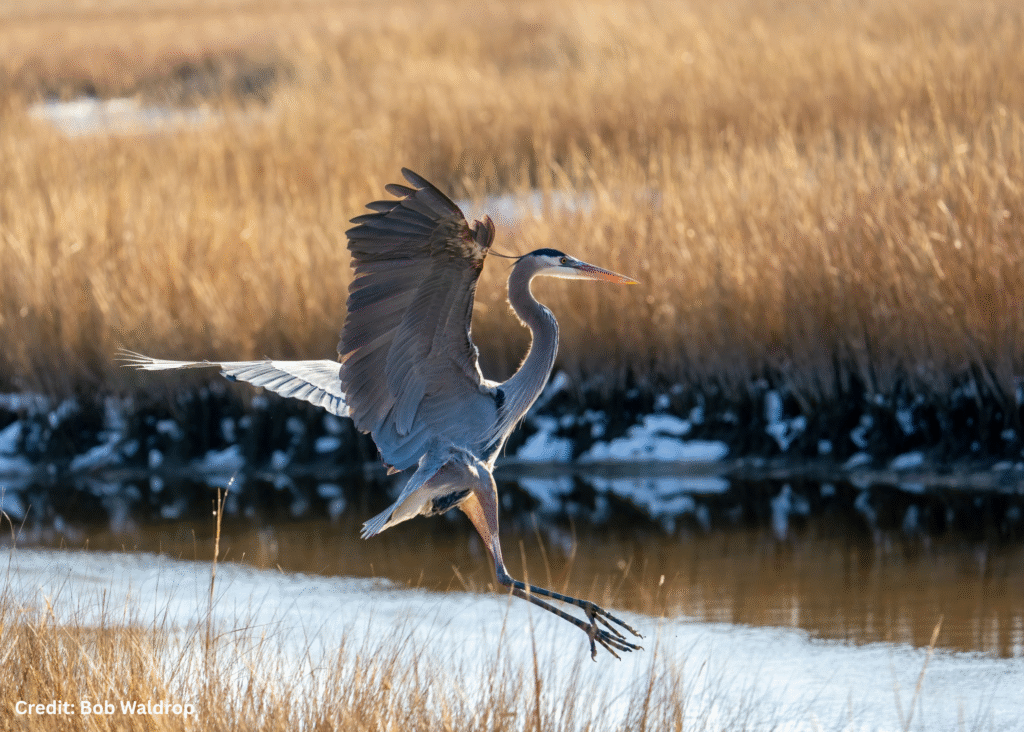
A year-round resident of Virginia’s River Realm, the Great Blue Heron becomes especially active and visible in spring as shallow waters warm and feeding opportunities increase. With its towering height and slow, deliberate movements along shorelines and wetlands, this iconic wading bird is one of the most reliable wildlife sightings for visitors exploring the region in early spring.
Great Blue Herons are tall, slate-blue wading birds with long legs, a long neck often held in an “S” shape, and a dagger-like bill; in flight, they appear large and slow-winged, with the neck tucked back.
Year-round, with peak visibility in spring when herons are actively feeding in shallow creeks, wetlands, and shoreline areas.
Great Blue Herons hunt in shallow water. Look for them standing along marsh edges, mudflats, and quiet creek banks where they wait to spear fish, crabs, and frogs. Scan the shoreline while boating or paddling, or visit a public waterfront access point for a good view from land.
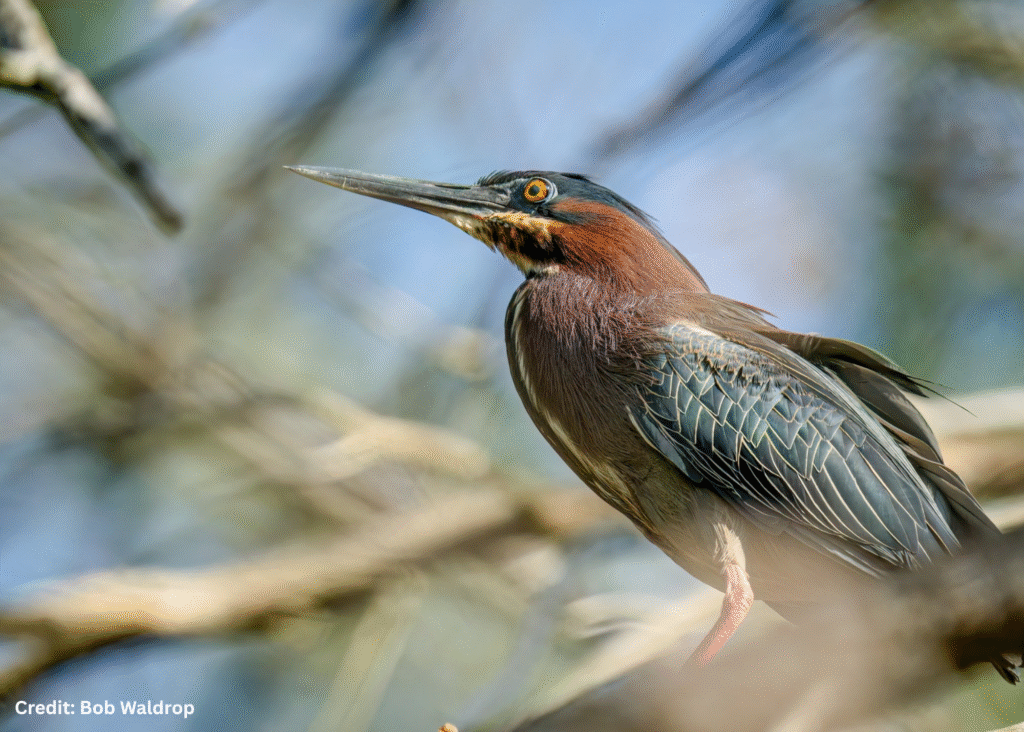
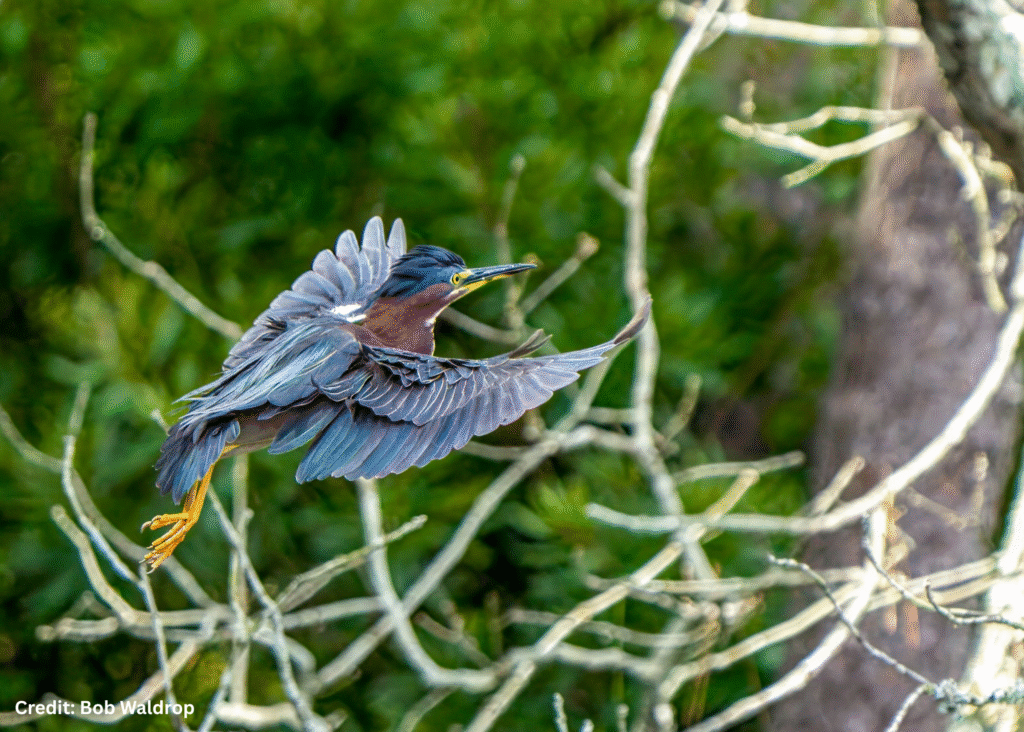
A quiet, watchful presence of spring and summer in Virginia’s River Realm, the Green Heron returns to local creeks and wetlands as the season warms. Smaller and more secretive than its larger heron cousins, this chestnut-necked wader is often spotted standing still along shaded shorelines before striking quickly at passing prey.
Green Herons are compact, crow-sized wading birds with a chestnut neck, grayish-green back, and dark cap, often seen hunched along the water’s edge or slipping into the trees along wooded creeks.
April through early fall, with the first arrivals typically appearing in early spring and activity peaking through late spring and summer.
Green Herons prefer quiet, sheltered water with thick shoreline vegetation. Look for them along wooded creek banks, marsh edges, and overhanging branches where they hunt fish, insects, and small frogs in shallow water. Scan shaded creek edges while paddling or boating, or watch the shoreline from a public waterfront access point.
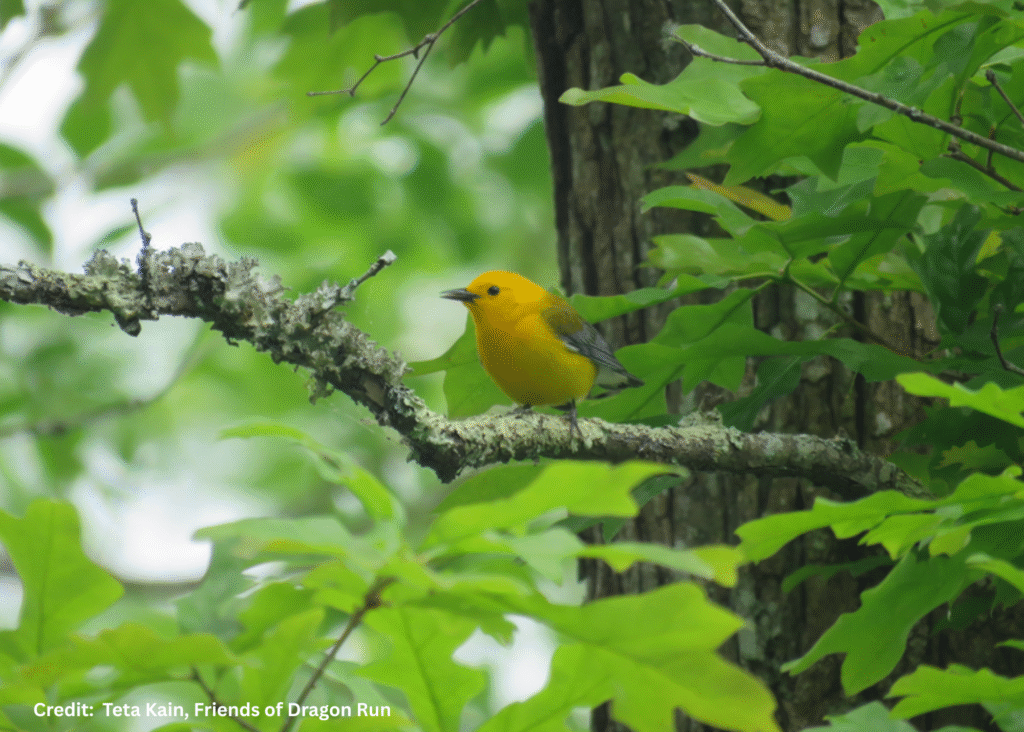
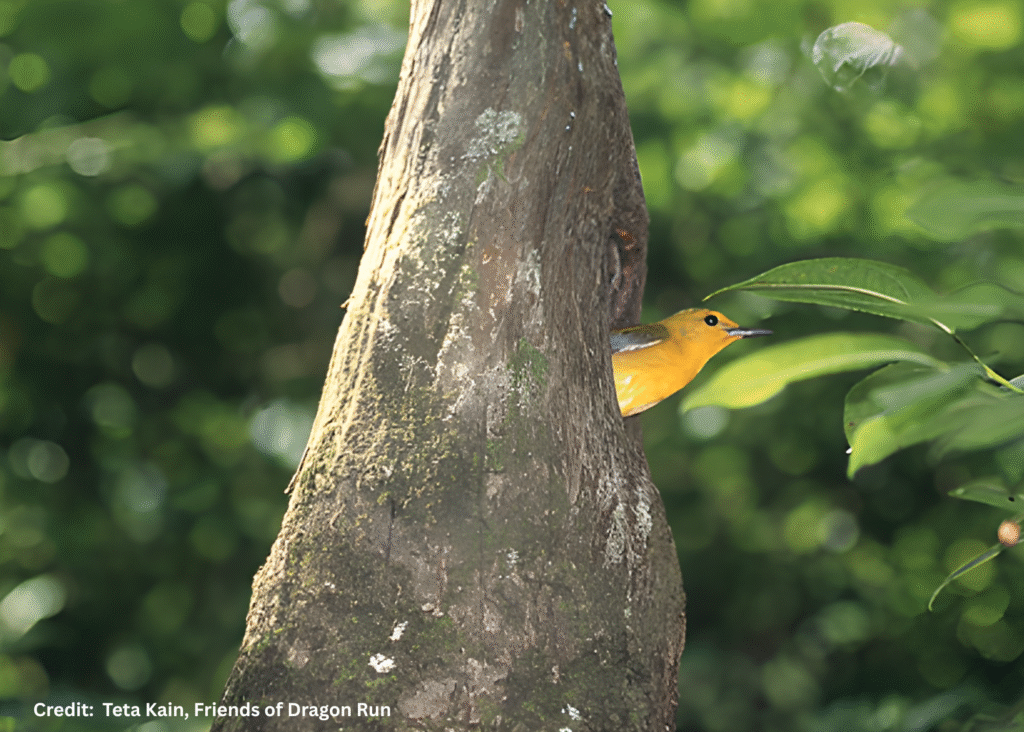
The Prothonotary Warbler returns each April to nest in swamp forests and flooded bottomlands along quiet creeks. Often called the “swamp canary,” this striking yellow songbird is a favorite sight for paddlers as it flits low over the water or perches along bald cypress knees.
Prothonotary Warblers are vivid golden-yellow birds with olive backs and bluish-gray wings, standing out brightly against the dark greens and browns of swamp forests.
April through summer, with peak visibility in spring as birds return to breed and establish nesting territories.
Prothonotary Warblers favor flooded forests, swamp edges, and slow-moving waterways with standing dead trees where they nest in natural cavities. Look for them moving through low branches above the water as they search for insects and other small prey. Quiet paddles through swampy creeks or visits to wooded wetlands offer the best chance to spot one.
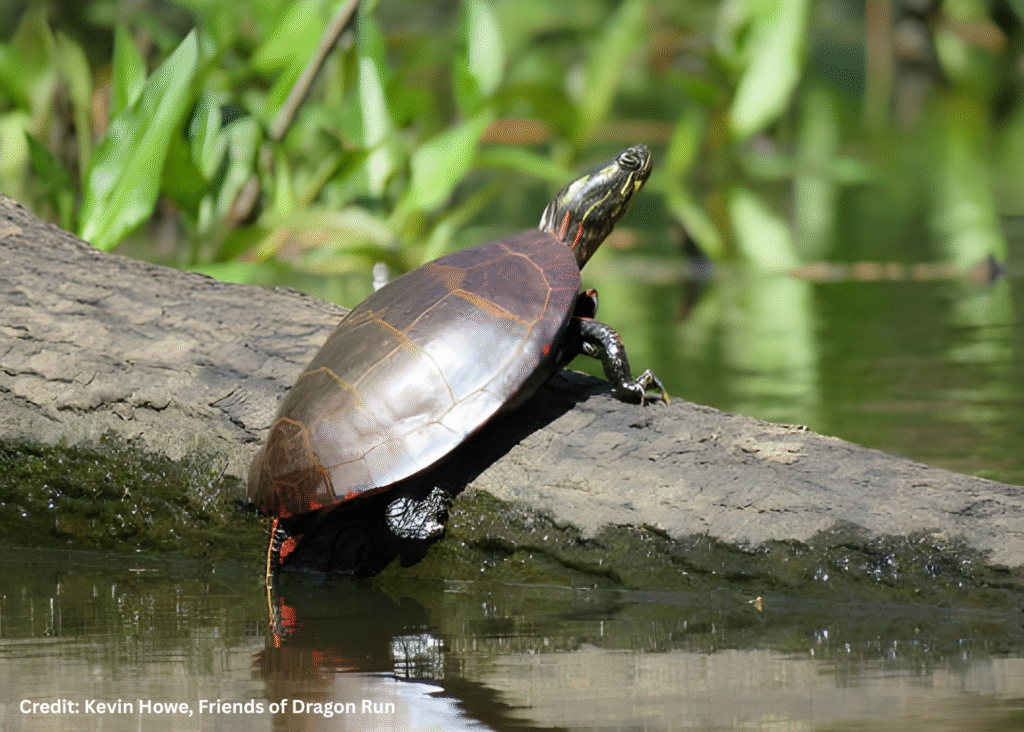
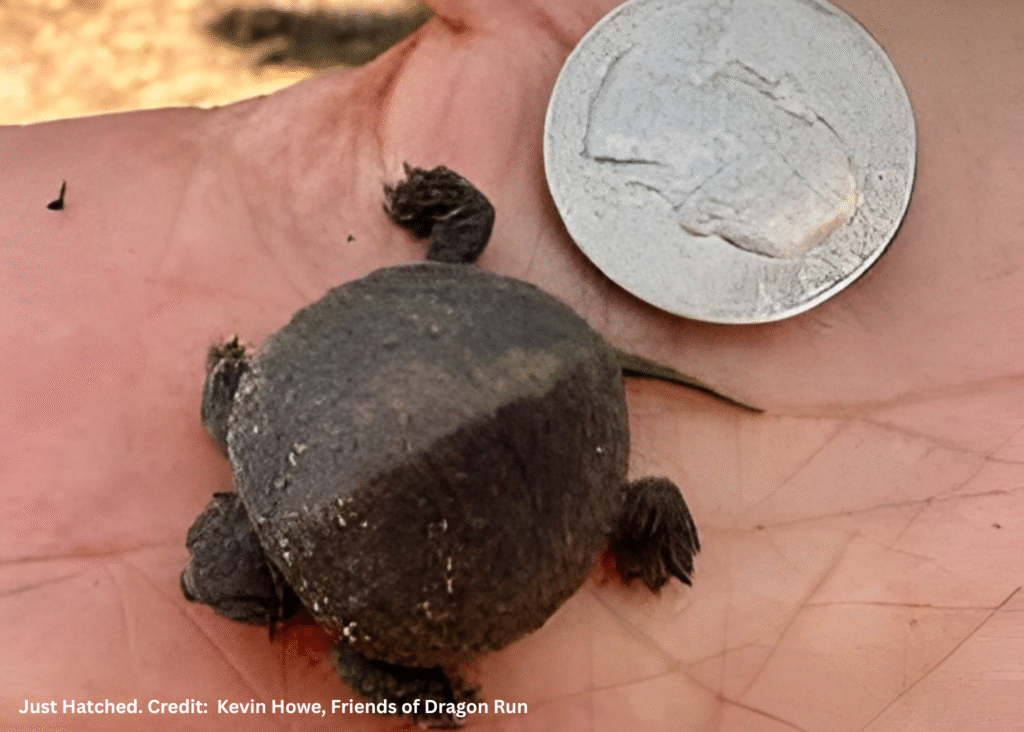
Eastern painted turtles emerge as sunny days return, basking on logs and banks along slow-moving creeks, ponds, and wetlands. These colorful native turtles are among the first reptiles visitors are likely to spot as winter fades, making them a favorite find for paddlers, boaters, and trail walkers alike.
Eastern painted turtles are small to medium-sized turtles with dark olive-to-black shells edged in red markings, a bright yellow underside, and thin yellow stripes along the head and neck—often seen sunning themselves in small groups.
Early spring through fall, with peak visibility on warm, sunny days when turtles climb out of the water to bask.
Eastern Painted Turtles prefer calm freshwater habitats such as ponds, wetlands, and slow backwaters with plenty of logs and rocks for basking. Look for them sunning themselves on exposed logs or along muddy banks on warm spring days. Freshwater swamps and low-salinity tidal creeks—like those found along the Dragon Run—offer some of the best opportunities to spot them.
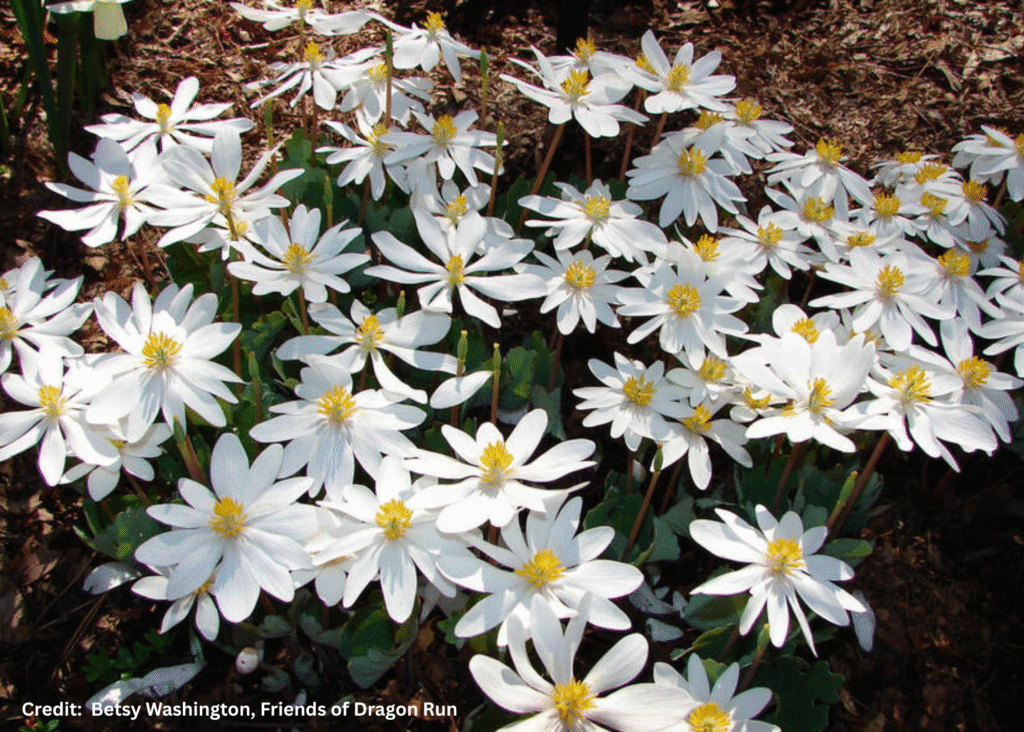
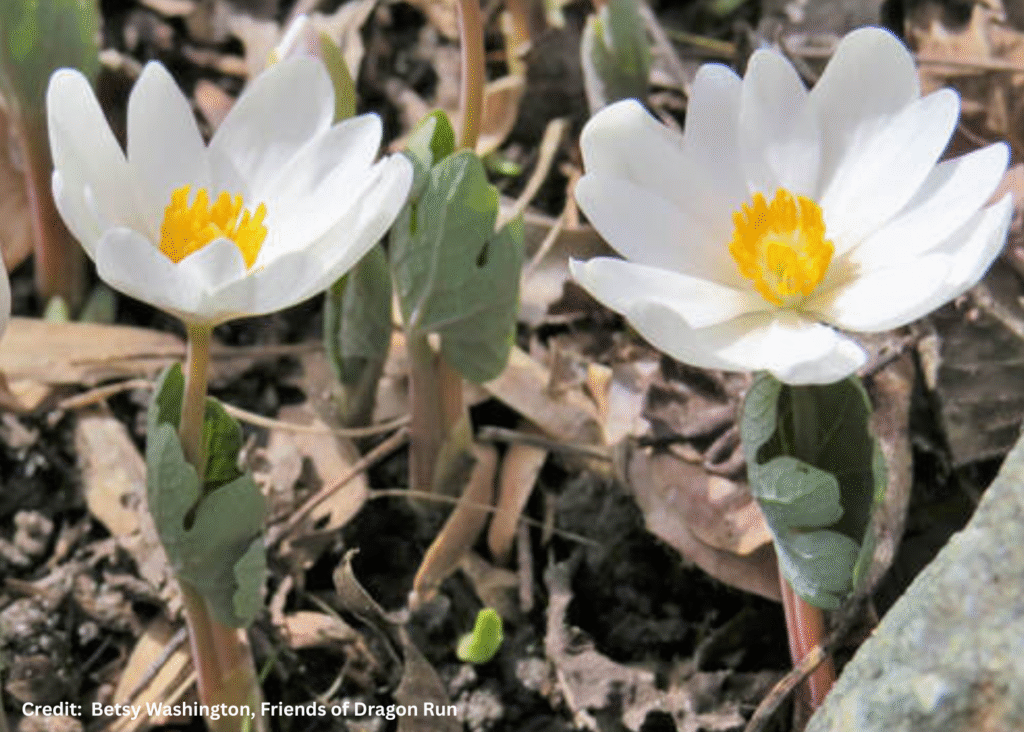
One of the earliest and most fleeting signs of spring in Virginia’s River Realm, bloodroot is a cherished wildflower that briefly lights up forest floors before tree canopies fully leaf out. Its snow-white blooms appear for only a short window in early spring, making each sighting feel like a small seasonal reward for those exploring shaded trails and woodland edges.
Bloodroot is a low-growing woodland wildflower with bright white, daisy-like blooms and a single curled leaf that often wraps protectively around the flower bud; its blossoms open wide on warm, sunny days and close again at night or during cold, rainy weather.
Early to mid-spring (often March), with blooms lasting only a few days depending on weather conditions.
Bloodroot grows in rich, shaded woodland soils. Woodland trails and moist forest floors offer the best chance to spot this short-lived spring ephemeral.
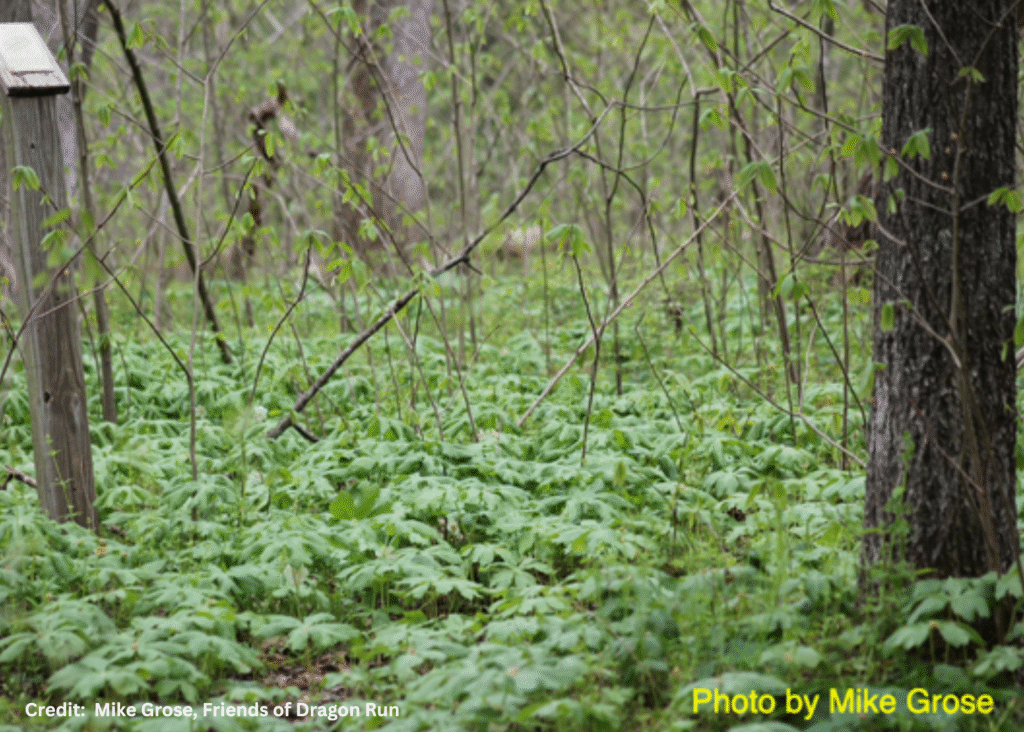
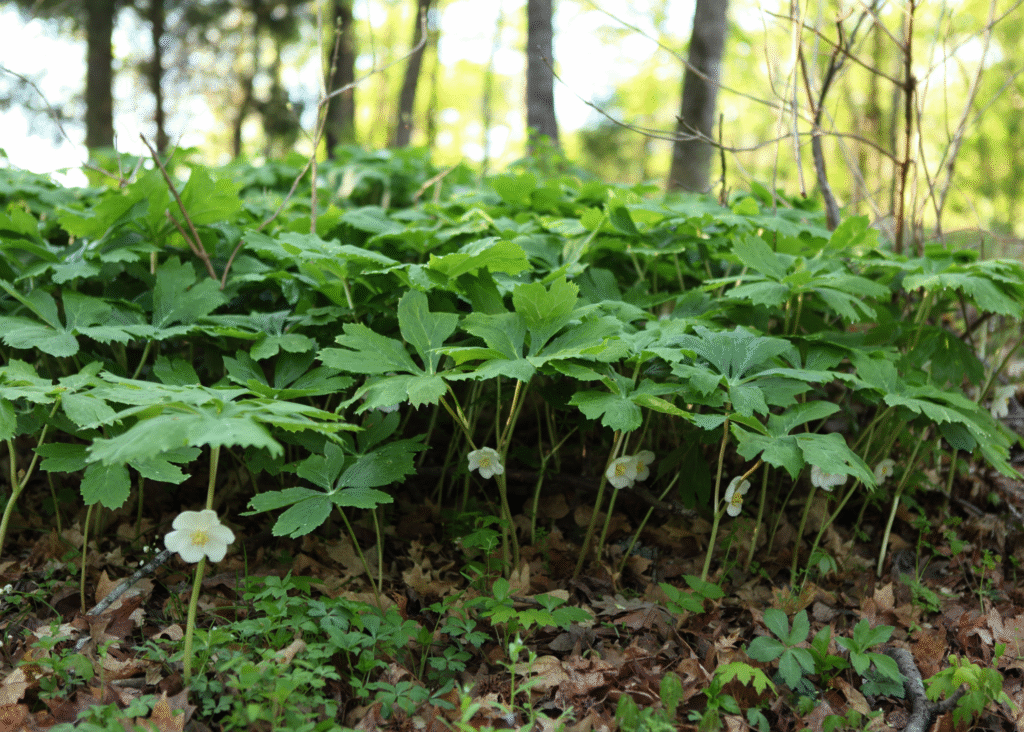
Mayapple emerges in colonies that create a sea of umbrella-like leaves across shaded woodlands in Virginia’s River Realm. These spring ephemerals bloom and leaf out briefly before fading back by early summer, making them a special find for those exploring forest trails during the heart of spring.
Mayapples have large, deeply lobed leaves that resemble little umbrellas on single stems; their small white flowers and developing fruit hang beneath the leaves, often hidden from view.
Early to mid-spring (typically March through May), with leaves and blooms appearing before the forest canopy fully fills in.
Mayapple grows in moist, rich woodland soils and is commonly found in shaded deciduous forests. It often forms large colonies across the forest floor, especially in areas with deep leaf litter and filtered spring sunlight before the canopy fully leafs out.
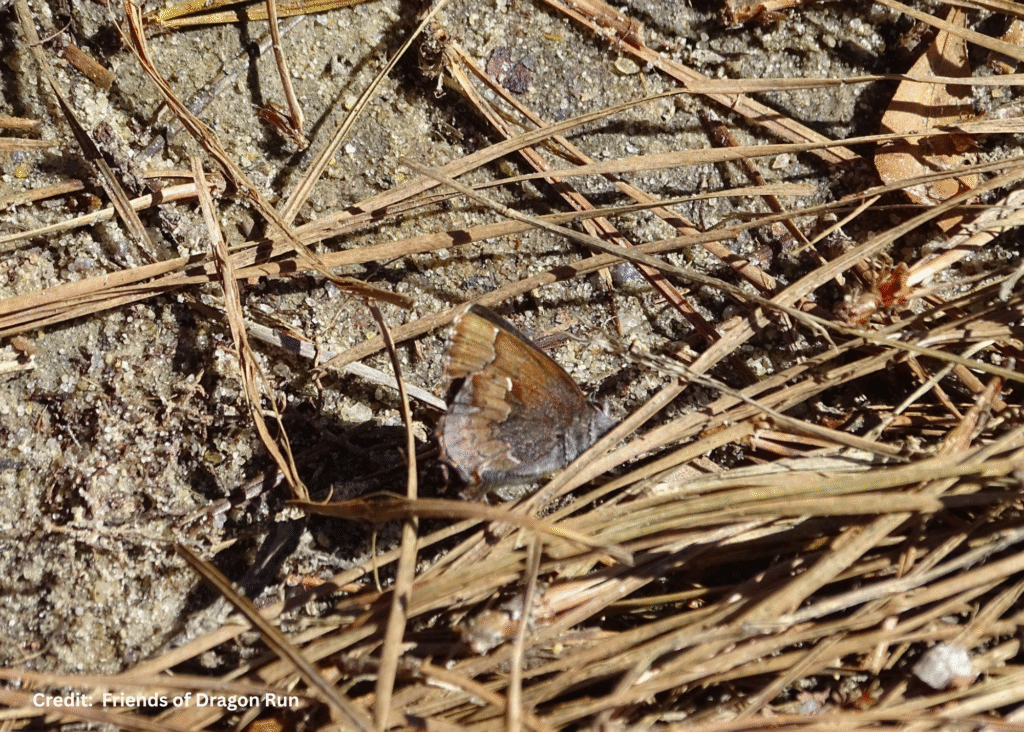
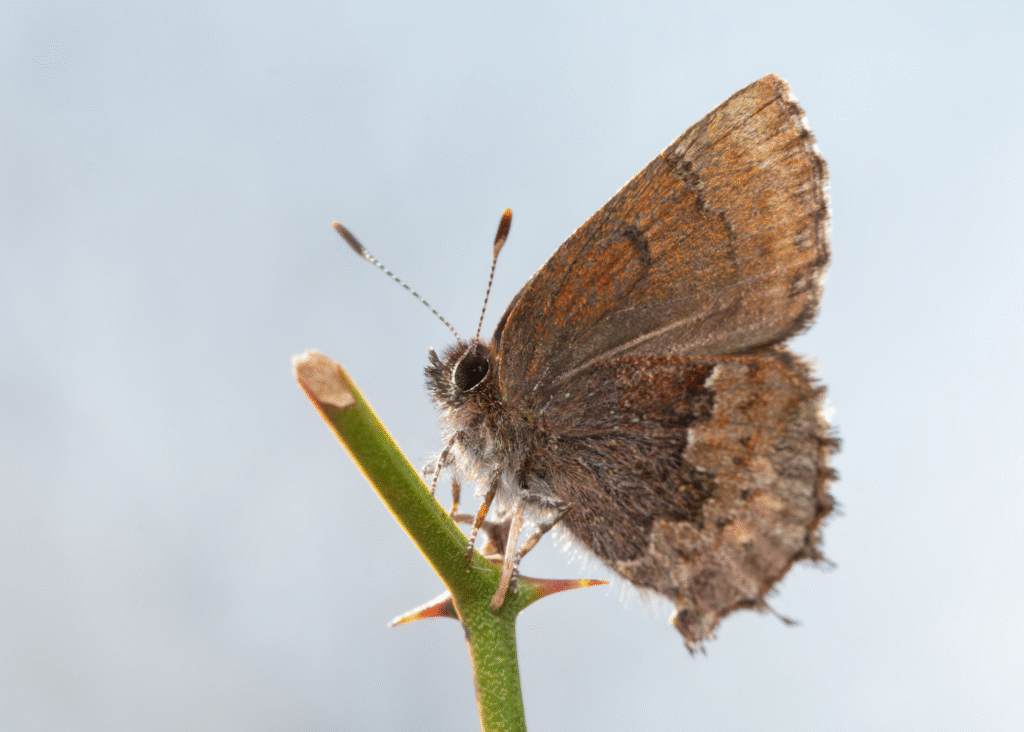
One of the earliest butterflies in Virginia’s River Realm, Henry’s elfin appears just as forests begin to wake up, fluttering through woodland edges and along shaded trails. Small and easily overlooked, this subtle butterfly is a fleeting reward for those exploring the woods in early spring, often seen darting low among budding shrubs and early blooms.
Henry’s elfin is a small brown butterfly with delicate white markings on the underside of its wings; it tends to perch low in vegetation or flit quickly through forest edges, blending easily into the leaf litter and branches.
Early spring, typically March through April, with activity peaking on warm, sunny days.
Henry’s Elfin is most often found in deciduous woodlands and forest edges, especially where its host plants such as redbud and holly grow. It favors sunny clearings, woodland trails, and shrubby understories where early spring nectar sources are available.
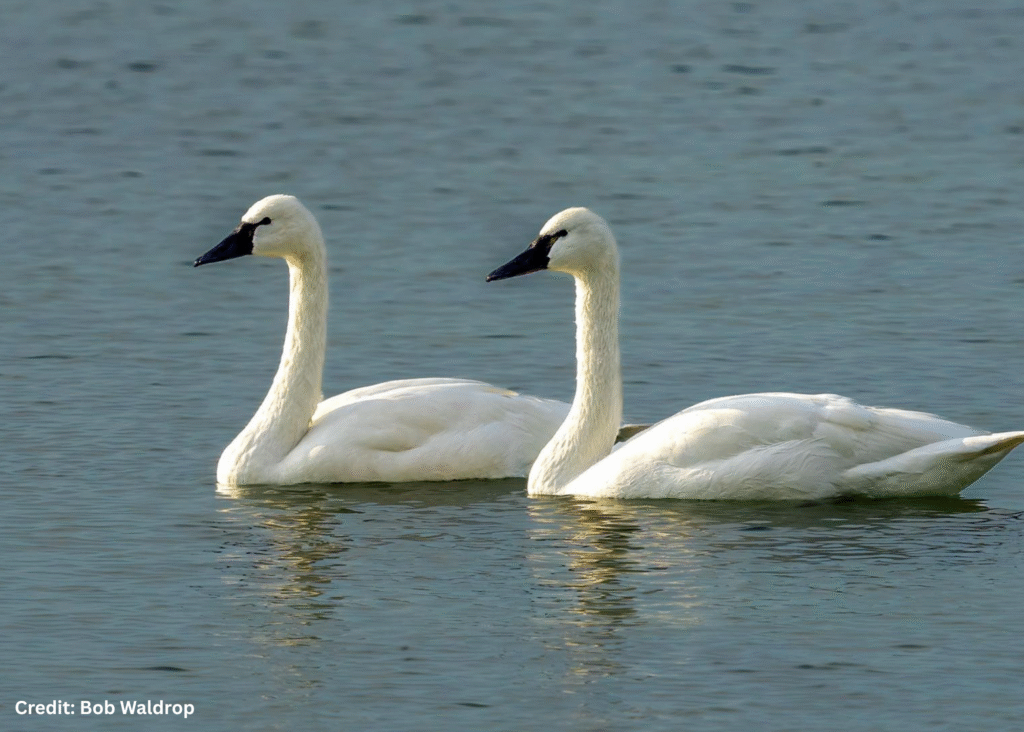
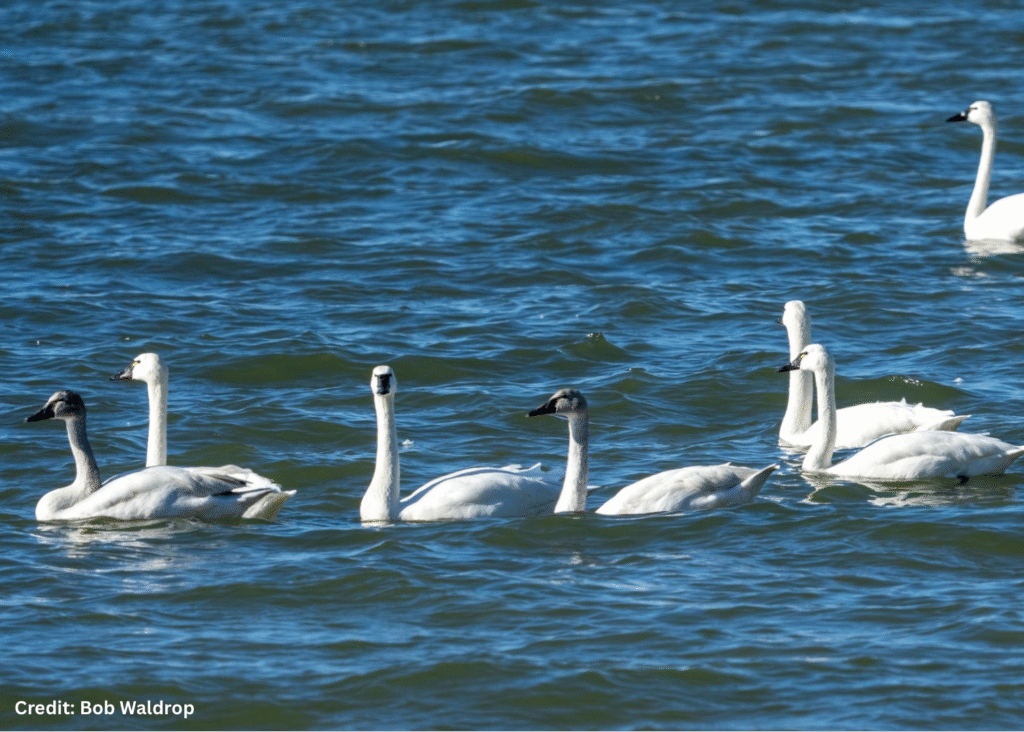
A highlight of winter in Virginia’s River Realm, Tundra Swans return each year from the Arctic tundra to feed, rest, and court along our creeks, rivers, and bays. These elegant birds mate for life, and their seasonal presence—often seen swooning, swanning, and strengthening pair bonds—has become a cherished winter tradition for locals and visitors alike.
Large and bright white with long necks and a black bill marked by a small yellow spot, Tundra Swans are often seen resting on open water or flying in flocks. They frequent shallow creeks, bays, wetlands, and nearby fields, feeding on aquatic plants, clams, and grains.
Late fall through early spring, with peak visibility in mid-winter (January–February) before they begin migrating back north to breed in the Arctic tundra.
Tundra Swans gather in shallow tidal waters where they can reach the bottom to feed on submerged plants and shellfish. Look for them resting or feeding in protected bays, river shallows, and the mouths of creeks during the winter months. Large flocks are often easiest to see from open shorelines or quiet waterways where the water remains shallow.
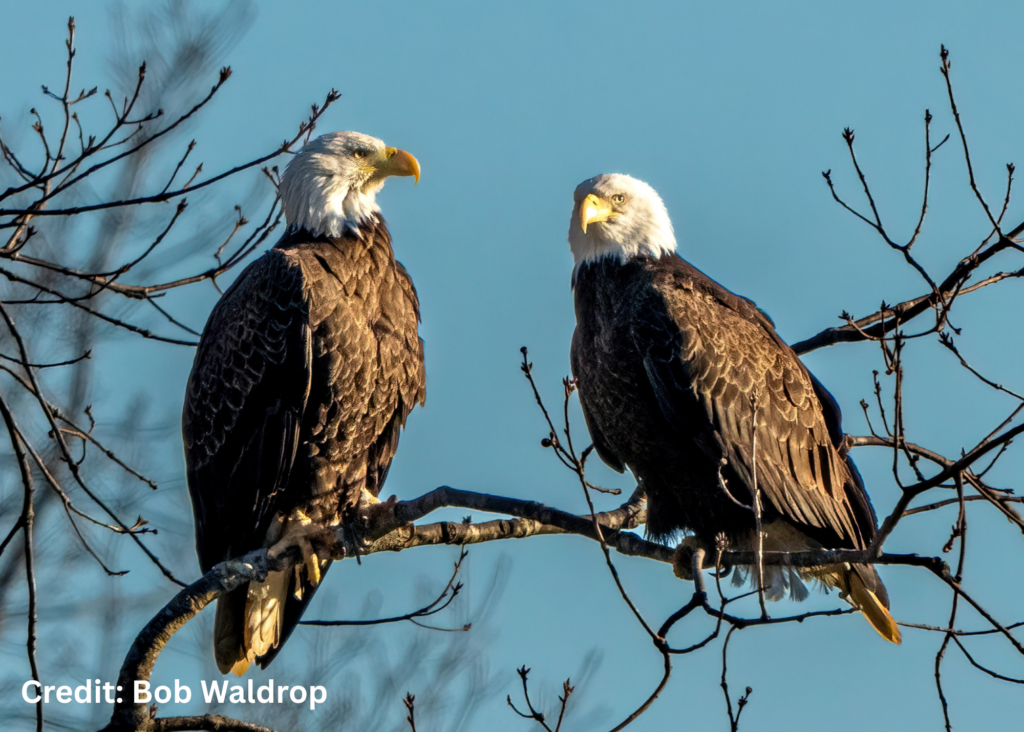
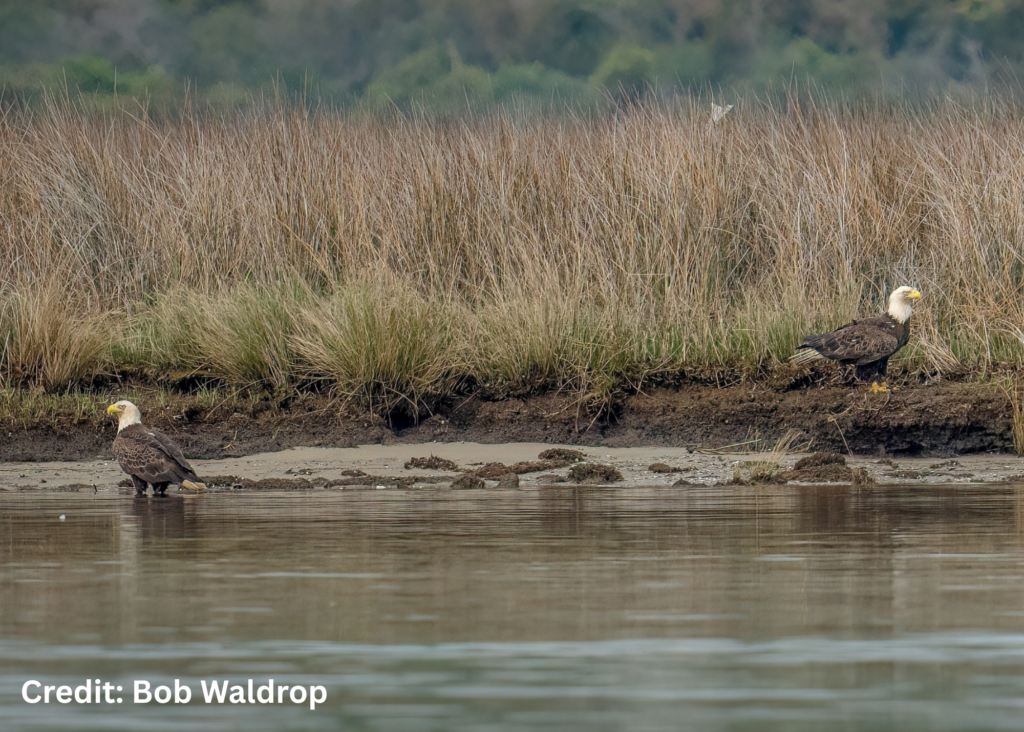
The Bald Eagle, America’s national bird, is one of the most iconic wildlife species found throughout Virginia’s River Realm. With its striking white head and tail contrasting against a dark brown body, the Bald Eagle is unmistakable as it soars high above creeks, rivers, and open water searching for fish. Once endangered due to habitat loss and pesticide use, Bald Eagle populations have made a remarkable recovery and are now commonly seen along the Chesapeake Bay and its tributaries. Their large stick nests—often reused and expanded year after year—can reach impressive sizes high in tall trees near the water.
Bald Eagles can be seen year-round in the region, but late winter through early spring (January–March) is an especially active time. During this period, many pairs are nesting, incubating eggs, or caring for young, making them easier to observe as they frequently travel between nest sites and nearby waters to hunt.
Bald Eagles favor large waterways, tidal rivers, creeks, and bays where tall shoreline trees provide nesting and perching sites near good fishing grounds. Look for them soaring above open water, perched high in pines or hardwoods along the shoreline, or gliding along marsh edges and riverbanks.
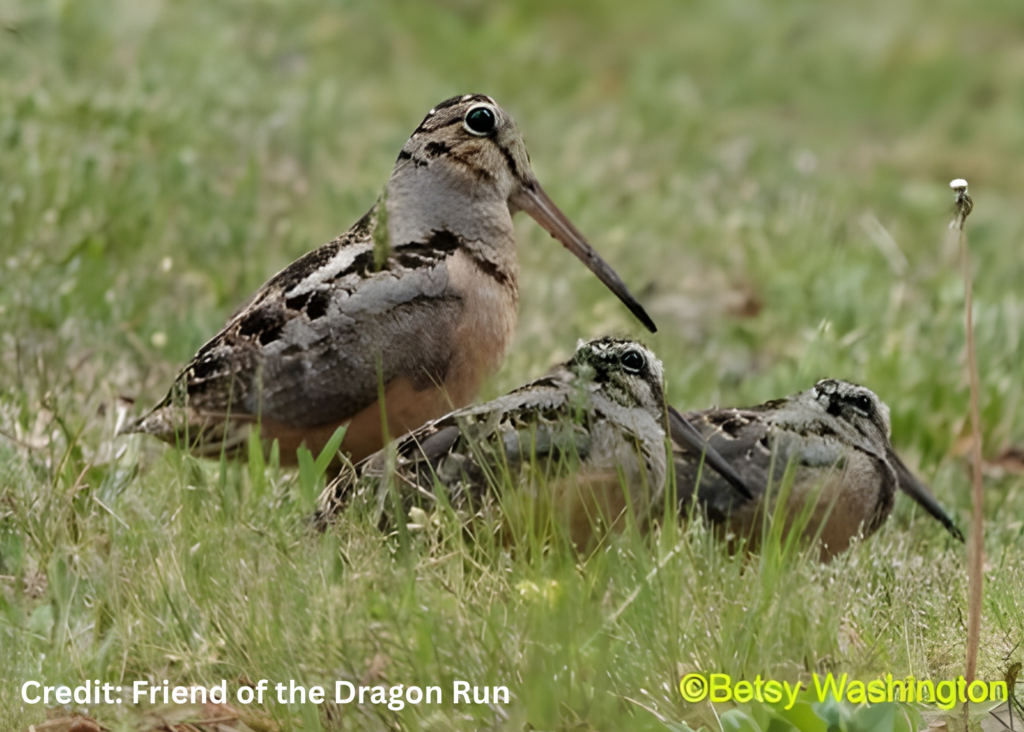
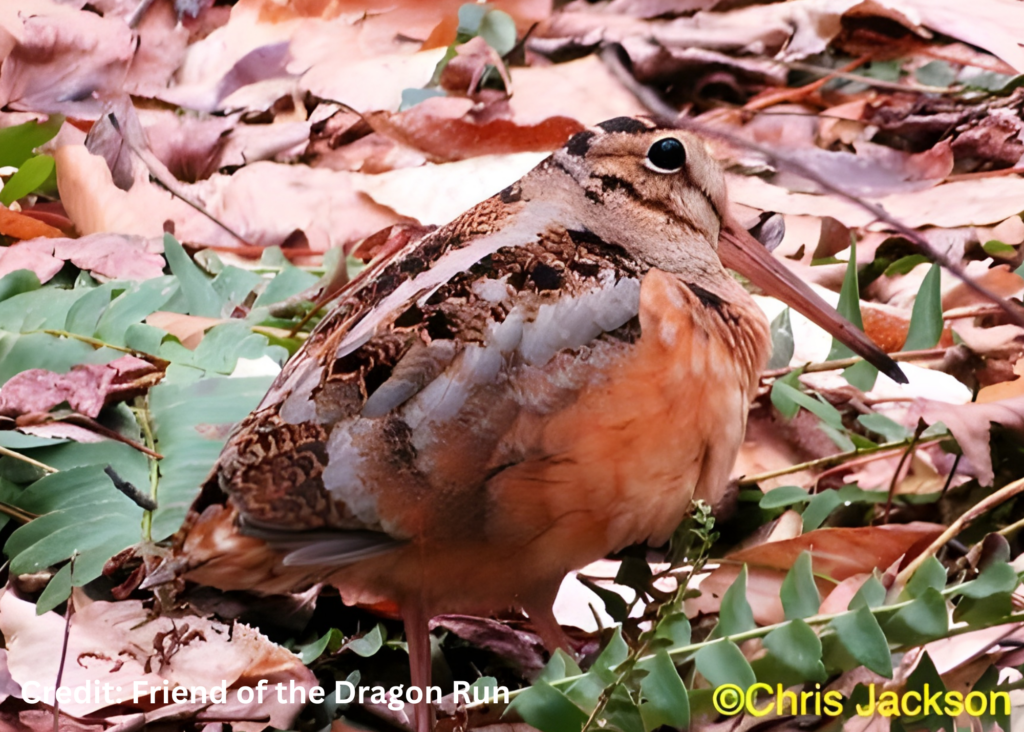
The American Woodcock is a small, secretive shorebird that spends most of its time on the forest floor, where its mottled brown feathers blend perfectly into the leaf litter. Despite being classified as a shorebird, woodcocks live in moist woodlands and brushy fields, using their long, sensitive bills to probe the soil for earthworms, insects, and other invertebrates. They are perhaps best known for their remarkable spring courtship display known as the “sky dance.” At dusk, males launch into the air in a spiraling flight before descending back to the ground while their wings create a distinctive musical twittering sound. Before each flight, they give a nasal call often described as “peent.” While they can be difficult to see, their sounds often give them away.
Most active late winter through early spring (February–April) during the breeding season. Listen at dawn or dusk, when males call and perform their aerial display flights.
American Woodcocks favor young forests, brushy fields, woodland edges, and regenerating clearings near moist forest soils where they can forage for earthworms. Listen for their calls in open clearings, early successional forests, and field edges near wooded wetlands or streams throughout Virginia’s River Realm.
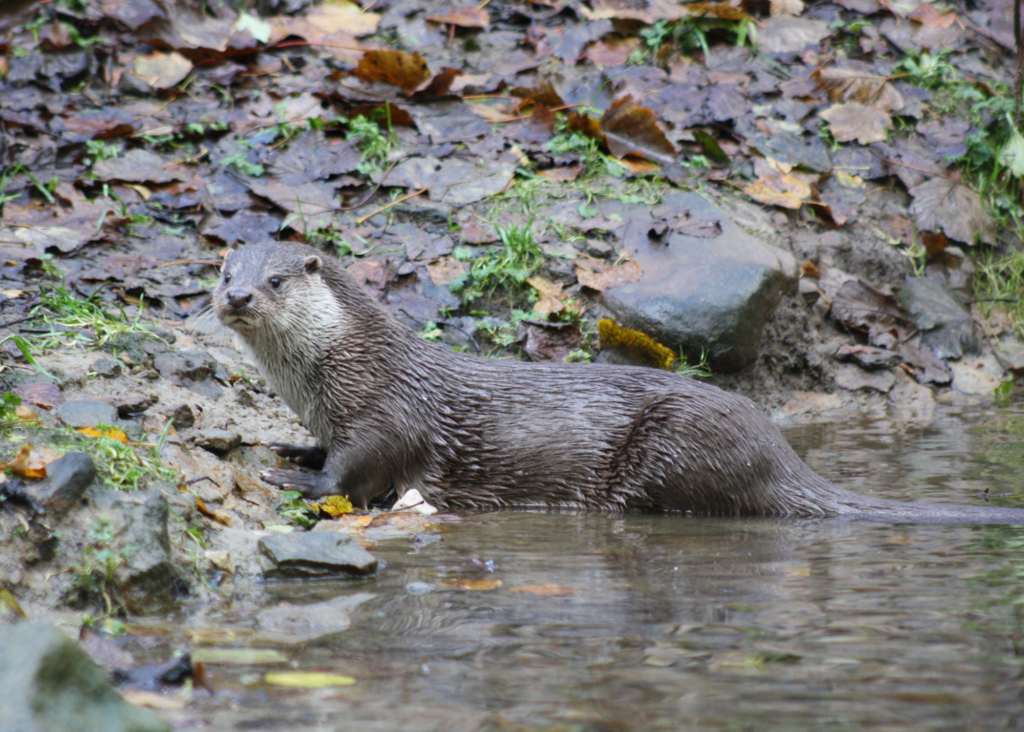
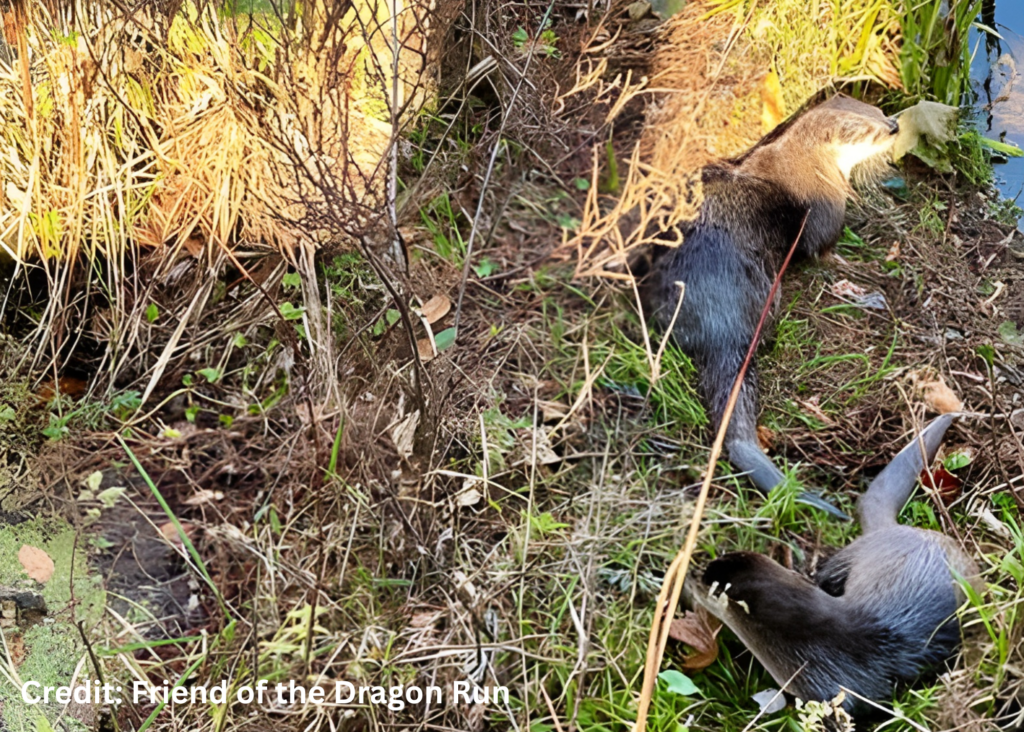
Playful, curious, and incredibly agile in the water, the North American River Otter is one of the most exciting wildlife sightings in Virginia’s River Realm. These sleek, semi-aquatic mammals are powerful swimmers, often seen diving, twisting, and sliding along muddy banks as they hunt for food. River otters feed on a variety of aquatic prey including fish, crayfish, frogs, mussels, and other small animals found in healthy waterways. Because they are sensitive to pollution and habitat loss, their presence is often considered a sign of clean, thriving ecosystems. While they can be elusive, those lucky enough to encounter one often witness their energetic behavior—sometimes traveling in pairs or small family groups.
River otters are active year-round, but sightings are often more likely late winter through early spring (January–April) when vegetation is sparse and otters are more frequently traveling along waterways. They are most active around dawn and dusk, though they may occasionally be seen during the day, especially in quiet areas.
River otters favor clean waterways with abundant fish and natural shoreline habitat. Look for them along tidal creeks, marsh edges, forested wetlands, and slow-moving rivers where muddy banks provide places to slide into the water or build dens. They are sometimes spotted swimming in pairs or leaving tracks and slides along the shoreline of quiet creeks and wetlands throughout Virginia’s River Realm.
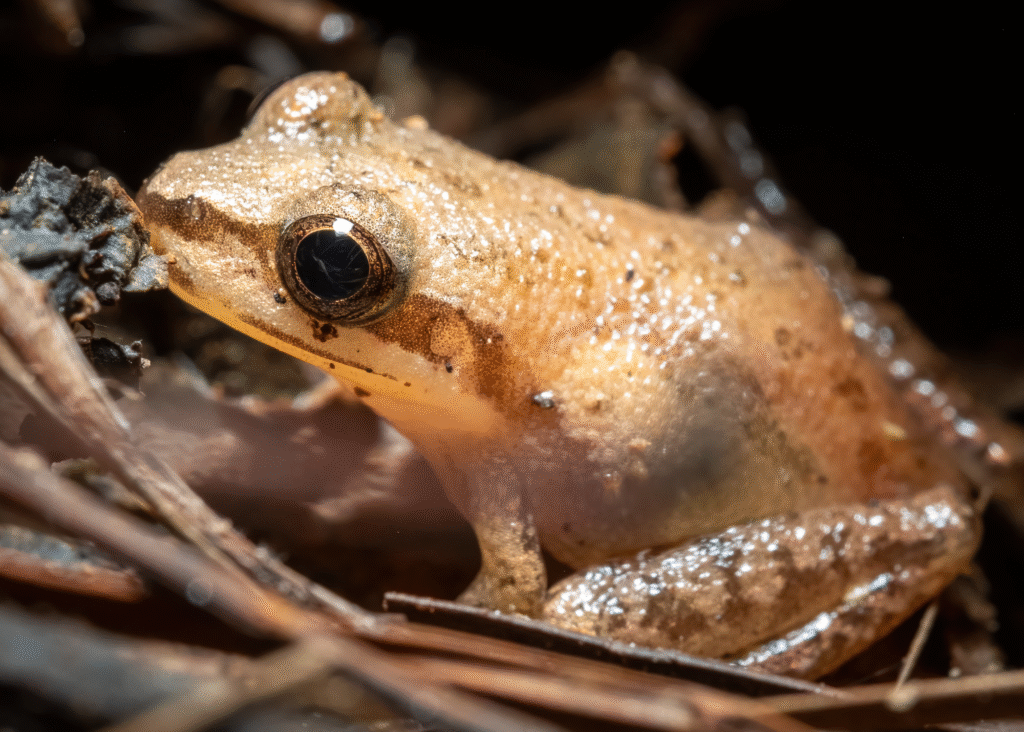
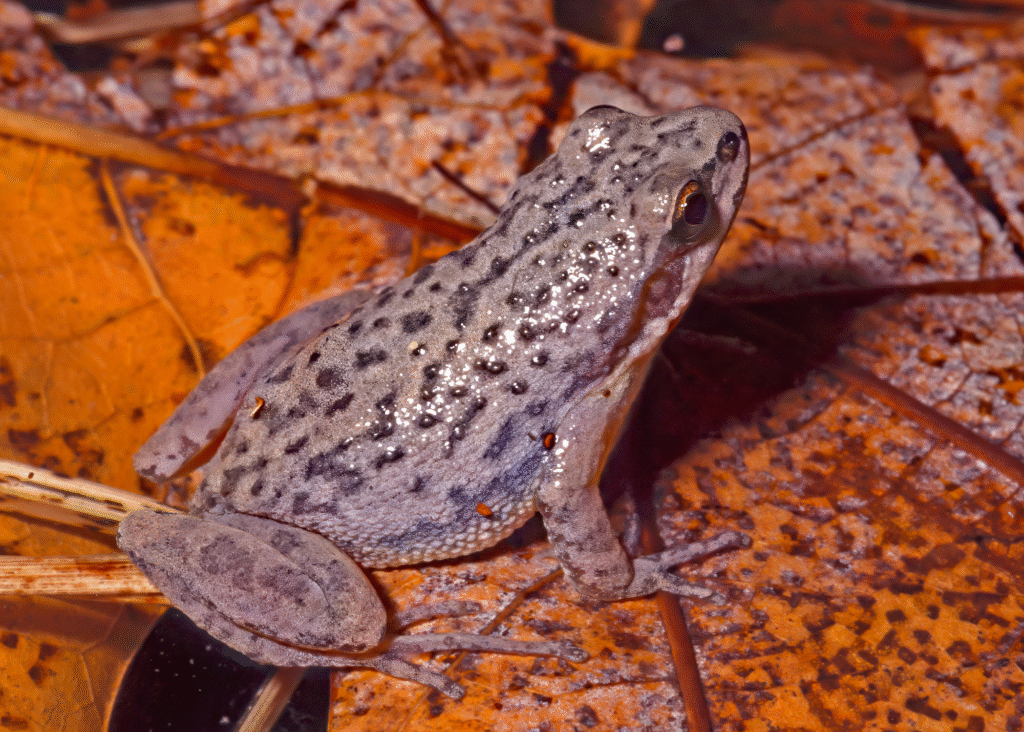
One of the first true sounds of spring in Virginia’s River Realm, upland chorus frogs announce the season from wetlands, swamp edges, and low-lying woods. Though small and often hidden, their high-pitched evening calls fill the air in late winter and early spring, signaling that warmer days—and new life—have arrived.
Upland chorus frogs are small, tan to brown frogs with darker stripes along their sides; they are more often heard than seen, calling from low vegetation or shallow water near wetland edges.
Late winter through early spring, with peak calling activity from February through April, especially on warm, damp evenings.
Swamp-edge and wetland trails; Low-lying wooded areas with seasonal pools; Boardwalks and trailheads near wetlands.
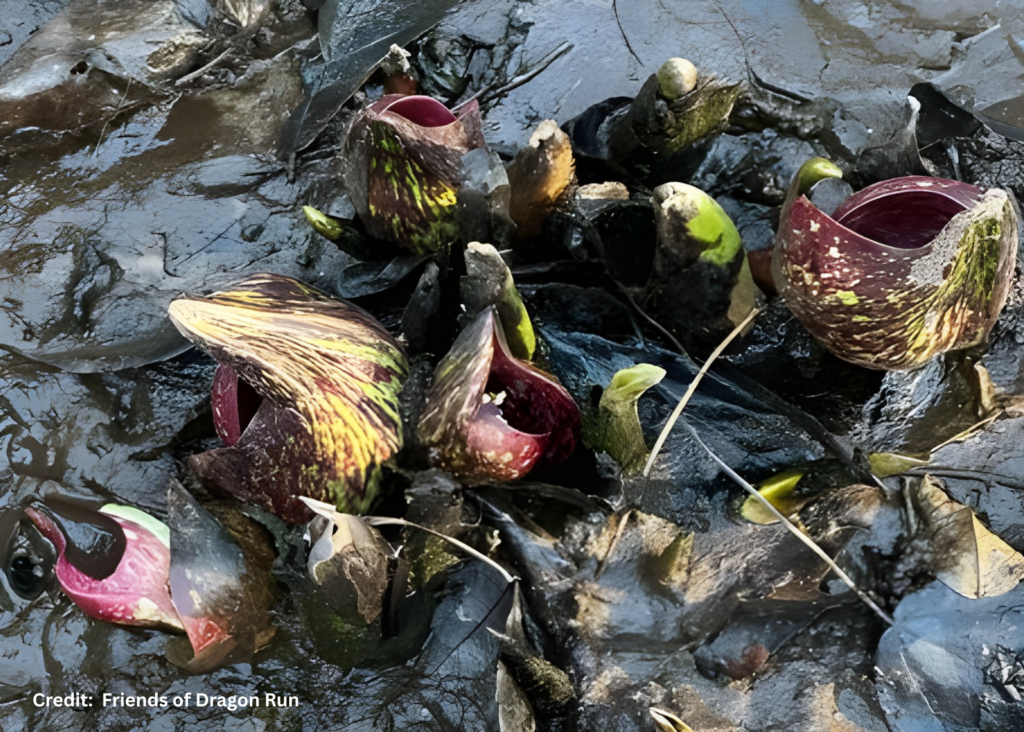
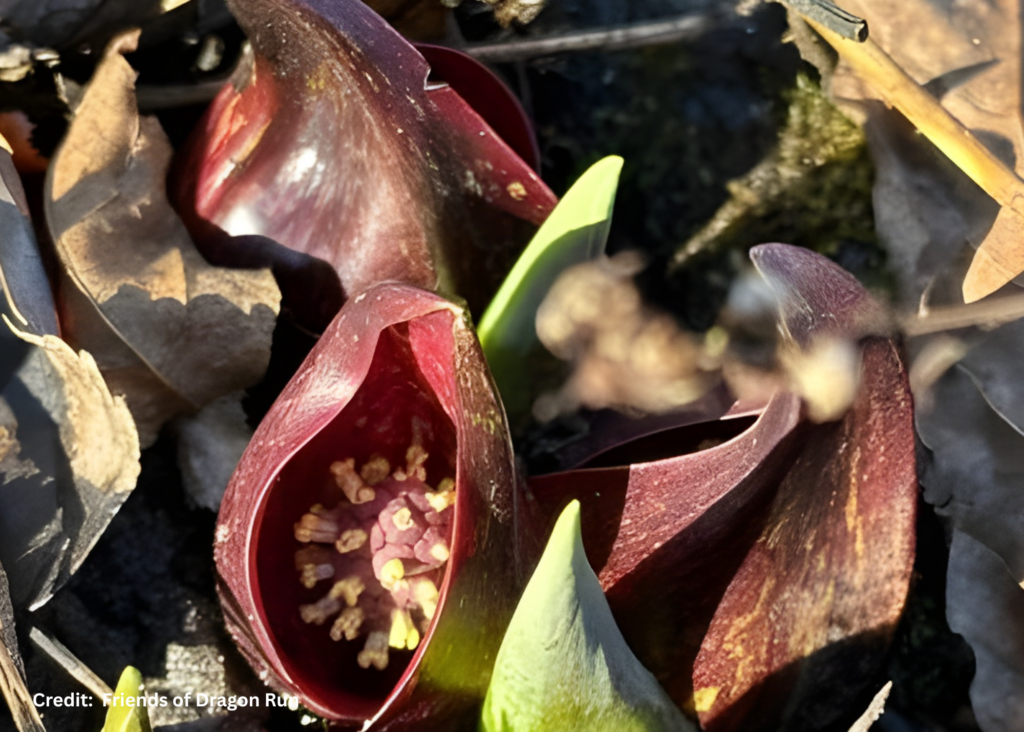
Skunk cabbage is one of the earliest signs that winter is loosening its grip on the landscape. Often emerging while snow is still on the ground, this unusual native plant pushes up mottled purple, hood-shaped flowers that generate their own heat to melt surrounding ice and attract early pollinators. Later in the season, large bright-green leaves unfurl, giving the plant its cabbage-like appearance. When bruised, the plant releases a strong odor—hence the name “skunk cabbage”—which helps attract insects that pollinate it. Though not particularly showy, it’s a fascinating species and a true herald of spring in wet woodlands.
Late winter through early spring, typically January-February. The distinctive purple flower structures usually appear first, sometimes pushing through frozen ground before the leaves emerge.
Look for skunk cabbage in wet woodlands, swampy areas, and along slow-moving streams or springs where the soil stays saturated.
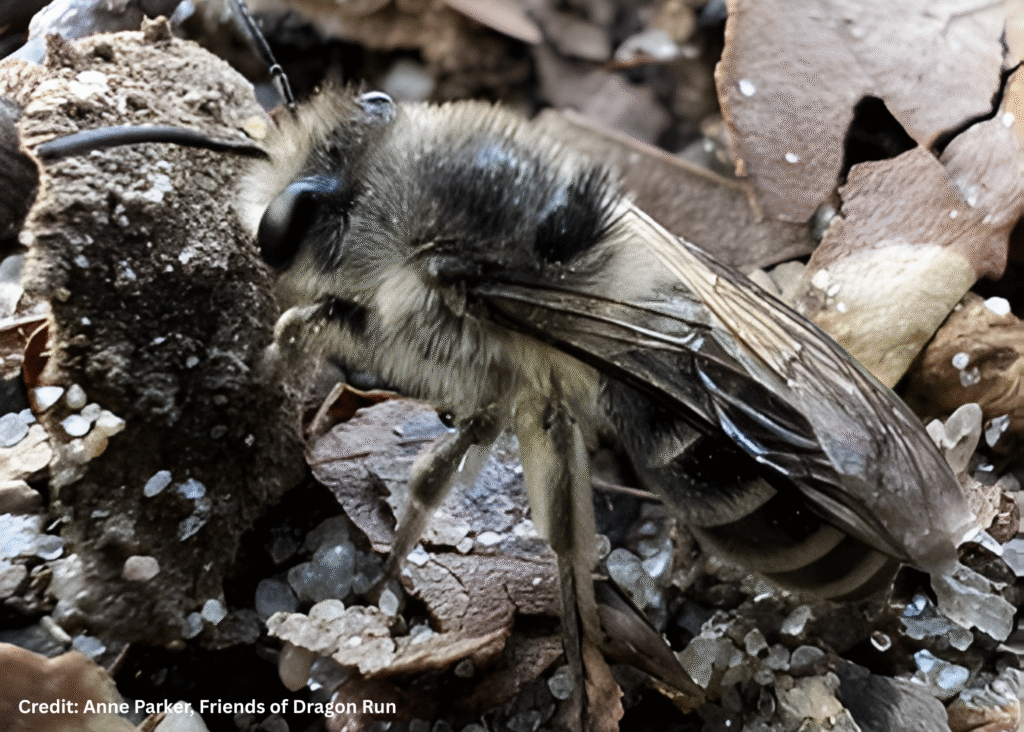
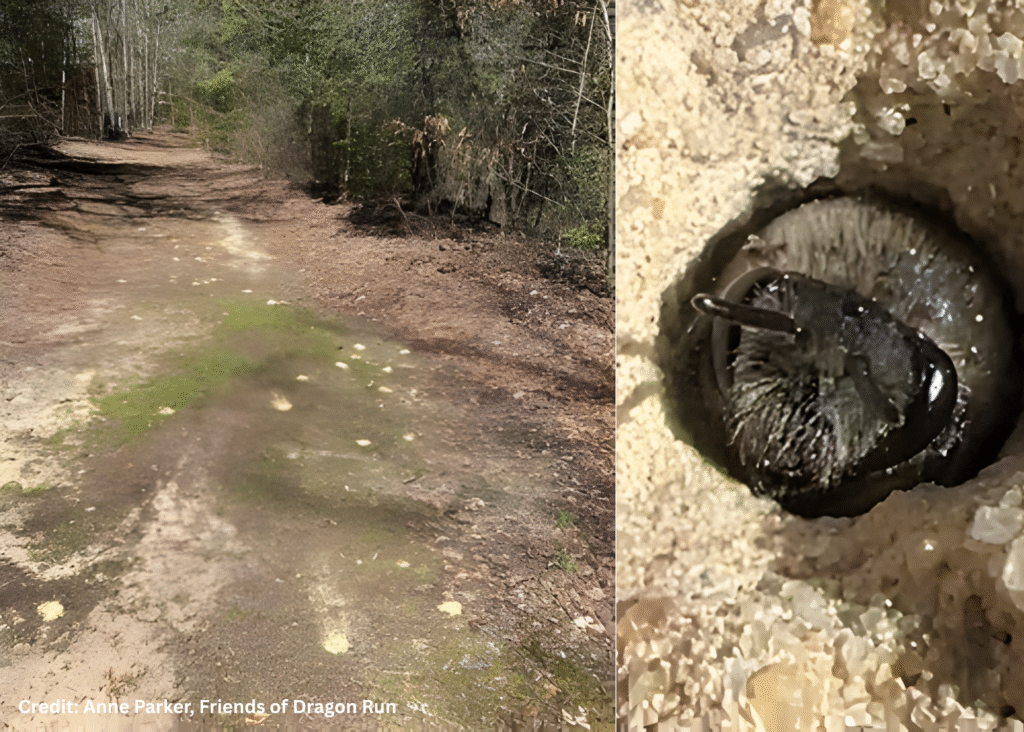
One of the quiet signs of early spring in Virginia’s River Realm, cellophane bees emerge as temperatures warm and wildflowers begin to bloom. These solitary, native bees are important pollinators of early spring flowers, often appearing in small groups as they nest in sandy soil along trails, banks, and open ground.
Cellophane bees are small to medium-sized native bees with fuzzy brown or tan bodies, often mistaken for small honeybees, and are most noticeable when seen hovering low over sandy ground or visiting early spring blooms.
Late winter through early spring, with peak activity from February through March and tapering into April, especially on warm, sunny days.
Sandy patches of ground along trails, launches, and parking areas; Bare soil near forest edges and early spring wildflowers; Open, sunny areas where the ground is undisturbed
Tip: If you see what looks like a cluster of tiny anthills, look closer—you may be standing near a cellophane bee nesting area. Watch from a distance and enjoy the activity without disturbing the nests.
Looking for a more personalized way to experience the wild side of the River Realm? Book an eco-tour with a local outfitter and explore alongside someone who knows these waters and habitats intimately. These guided experiences offer a deeper look at the region’s wildlife, history, and ecosystems—helping you notice the details you might otherwise miss. Start with trusted local operators like Rappahannock Adventures in Tappahannock and Chesapeake Eco-Tours in Urbanna.
For a more community-driven experience, sign up for a seasonal outing led by local organizations. Friends of the Dragon Run (FODR) offers guided paddles throughout spring, summer, and fall, providing access to one of the most pristine waterways in Virginia. You’ll also find unique events from groups like the Northern Neck Audubon Society, including experiences like the American Woodcock Walk, where you can witness one of nature’s most fascinating spring rituals.
Sit back, relax, and let someone else do the navigating while you take in the scenery. A captained boat cruise offers a comfortable way to explore the rivers and creeks, with plenty of opportunities to spot osprey overhead, herons along the shoreline, and other wildlife along the way. It’s a perfect option for those looking to enjoy the water without needing their own boat or gear.
Prefer to go your own way? Virginia’s River Realm is filled with public access points, parks, trails, and waterways just waiting to be explored. Whether you’re walking a shaded forest trail in search of spring blooms, scanning the shoreline from a dock, or paddling quietly through a tidal creek, you never know what you might discover. Use our directories to find the perfect place to start your own wildlife adventure.